
Meaning and mechanism
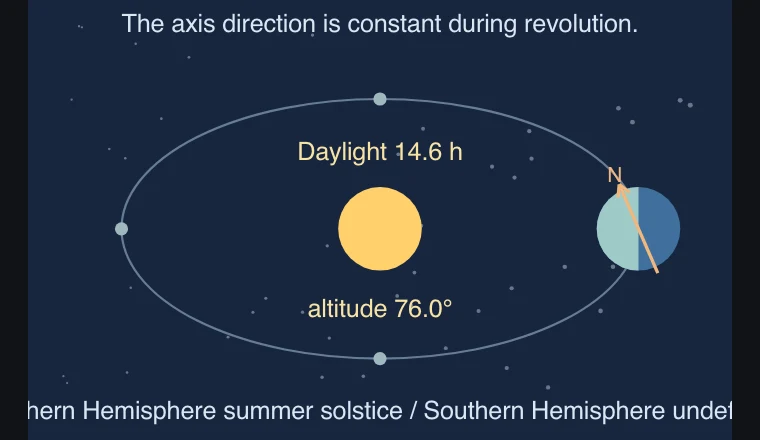
Earth’s rotation axis is tilted relative to the direction perpendicular to its orbital plane. The axis keeps nearly the same orientation over the year, changing the sunlight conditions in each hemisphere.
If the sun is high and the day is long, the amount of energy a unit area receives in a day can increase. This is not simply because the distance between the sun and the Earth is closer during summer.
Relationships and conditions
Solar altitude at local noon can be written as 90°−|φ−δ|, using latitude φ and solar declination δ. Polar regions can also experience continuous daylight or continuous darkness.
The simulation assumes a circular orbit and a fixed rotation-axis orientation. Actual seasonal temperatures do not change exactly in step with incoming sunlight because of ocean and atmospheric heat capacities, terrain, and thermal time lags.
What to observe in the simulation
Axial tilt creates seasonal differences in sunlight. The two hemispheres have opposite seasons, and the sun may not set or rise at the poles.
Assume a circular orbit and a fixed rotation axis. Atmospheric refraction, solar disk size, topography, and orbital eccentricity are omitted. A negative southern altitude means the sun is below the horizon. At a 0° tilt, the pole's center of the sun is along the horizon, so the length of the day is expressed by the convention of 12 h.
Key relationships and symbols
h=90−|φ−δ| · cos H=−tan φ·tan δ
| Symbol | Meaning | Unit |
|---|---|---|
| φ | Observer’s latitude | ° |
| δ | Solar declination | ° |
| h | Solar altitude at local noon | ° |
Worked example
At 37.5° N and an axial tilt of 23.5°, what is the solar-noon altitude at the June solstice?
The summer solstice solar declination is δ=23.5°, so 90−|37.5−23.5|=76°. At the same time, 37.5° south latitude is 29°.
Common misconceptions
- Summer in the Northern Hemisphere does not mean summer in the Southern Hemisphere; their seasons are opposite.