
CONCEPTS / ENERGY
Energy & Environment concepts
Explore the principles, key relationships, examples, and model limits in energy & environment, then test them in related experiments. These 10 concepts connect to 10 experiments.
All energy & environment experiments →Renewable energy

Solar cells and the maximum power point
The output of a solar cell is calculated by multiplying voltage and current. Neither the voltage nor the current alone represents the maximum power.
Read the concept →
Wind energy and the power coefficient
The rate of kinetic energy transported by wind is proportional to the cube of wind speed, assuming the same density and area. The turbine cannot recover all of this energy.
Read the concept →
Hydroelectric power and hydraulic head
Available hydropower depends on the mass of water flowing per unit time and the height difference. Flow rate and hydraulic head are separate conditions.
Read the concept →
Water electrolysis and hydrogen fuel cells
Electrolysis uses electrical energy to produce hydrogen; a fuel cell converts hydrogen’s chemical energy back into electrical energy. The round trip involves losses.
Read the concept →Heat and efficiency
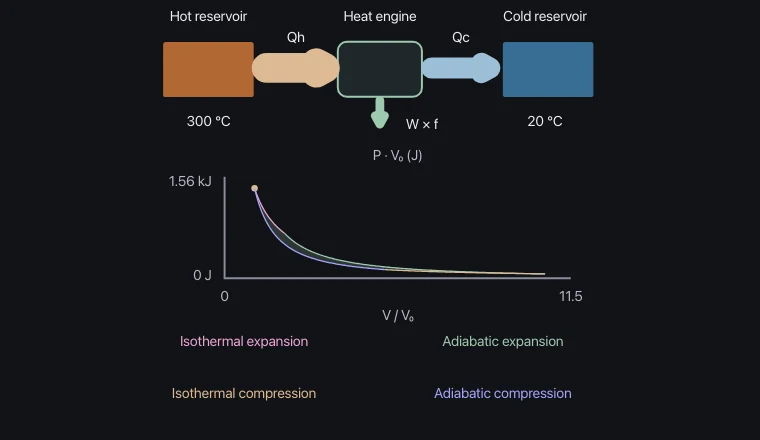
Heat engines and Carnot efficiency
A heat engine converts part of the heat it receives into work and rejects the rest at a lower temperature. Carnot efficiency is the reversible limit between two specified temperatures.
Read the concept →
Heat pumps and coefficient of performance
A heat pump moves heat from outside to provide heating. Delivering more heating energy than the work supplied does not violate energy conservation.
Read the concept →
Building insulation and thermal resistance
Insulation reduces heat transfer caused by temperature differences. Even at the same thickness, different thermal conductivities give different thermal resistances.
Read the concept →Storage and grids
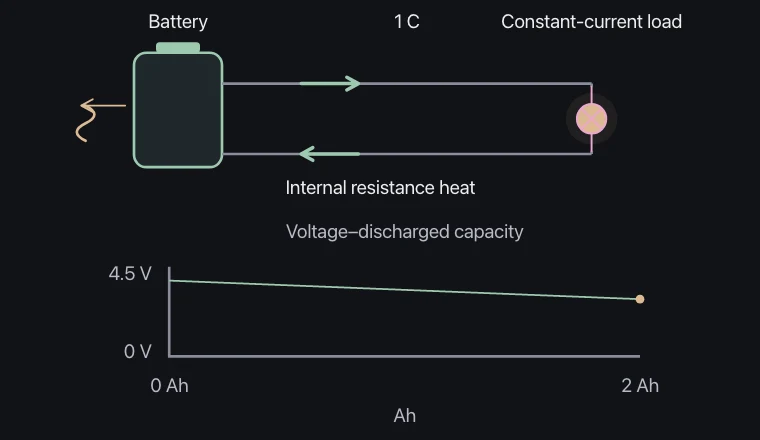
Battery capacity and discharge rate
The Ah of a battery corresponds to the amount of electric charge, while the Wh represents energy. If the voltage and discharge conditions are different, even the same Ah value will result in a different amount of energy obtained.
Read the concept →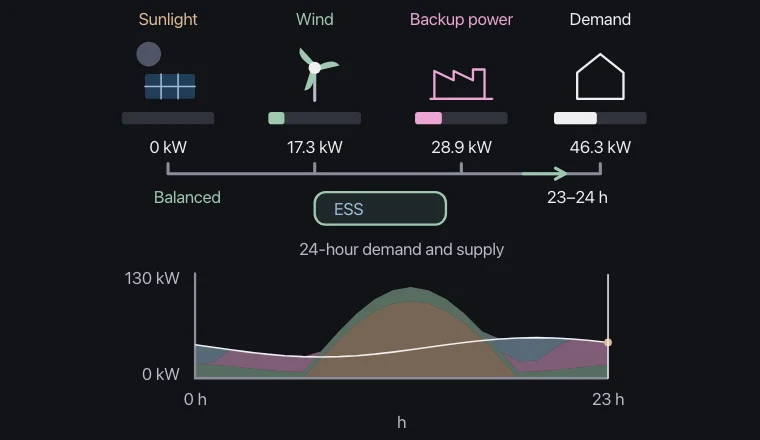
Electricity supply, demand, and storage
The electricity grid must balance supply and demand at each moment. Equal total daily generation is not enough if its timing differs from demand; storage or supplementary supply is then needed.
Read the concept →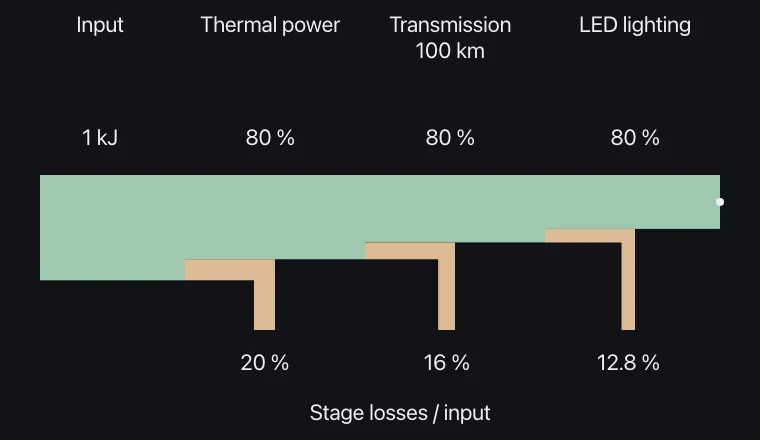
Energy conversion chains and overall efficiency
The overall efficiency of a continuous conversion process is calculated by multiplying the efficiencies of each stage. The loss in each stage is determined by comparing it to the energy entering that stage.
Read the concept →