
CONCEPTS / COMPUTING
Computing concepts
Explore the principles, key relationships, examples, and model limits in computing, then test them in related experiments. These 12 concepts connect to 12 experiments.
All computing experiments →Algorithms

Sorting algorithms and computational cost
Even when algorithms produce the same results, the specific comparisons and data movements required differ. We distinguish between the number of operations performed and the actual execution time.
Read the concept →
Binary search and the sorted-input requirement
Binary search involves comparing the midpoint of a sorted dataset to identify and exclude unnecessary halves. Initially, a rule is needed to maintain a candidate range.
Read the concept →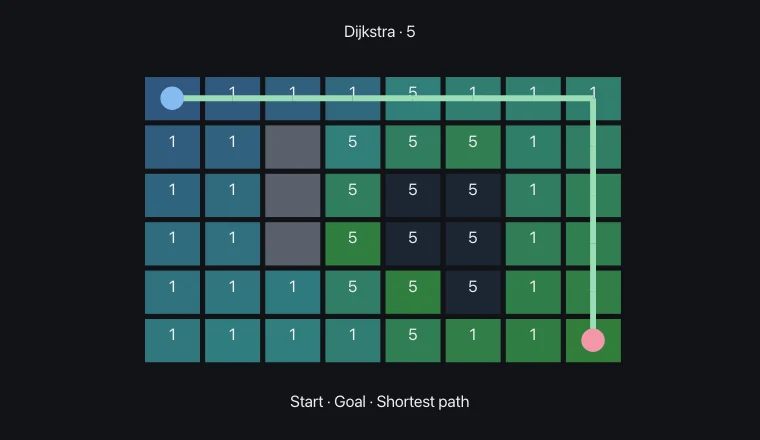
Shortest paths and graph search
The criterion of “shortest” can be based on the number of moves, or the sum of costs. If the edge costs differ, then the length of the shortest path and the minimum cost length will change.
Read the concept →Data representation

Binary numbers and character encoding
A bit sequence’s meaning depends on how it is interpreted. The same 0s and 1s can represent integers, characters, or colors.
Read the concept →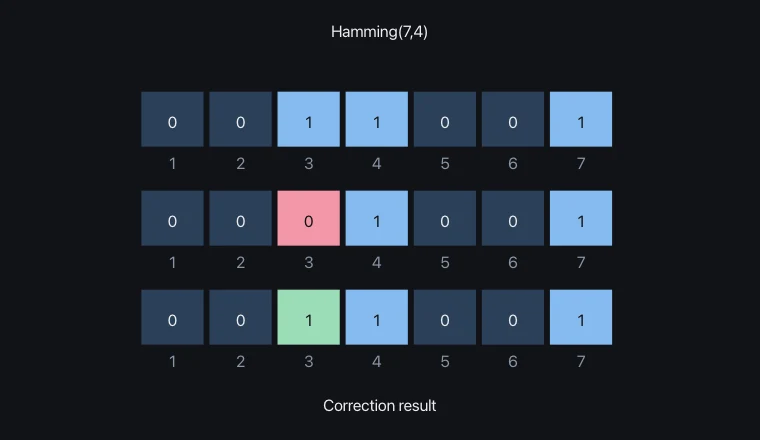
Error detection and Hamming codes
Error-correcting codes add redundant bits to increase the differences between valid data representations. Only a limited number of errors can be guaranteed detectable or correctable.
Read the concept →
Lossless compression and information entropy
Compression utilizes the repetition or differences in frequency within data to represent it with fewer symbols. However, no single method can always reduce all inputs to a smaller size.
Read the concept →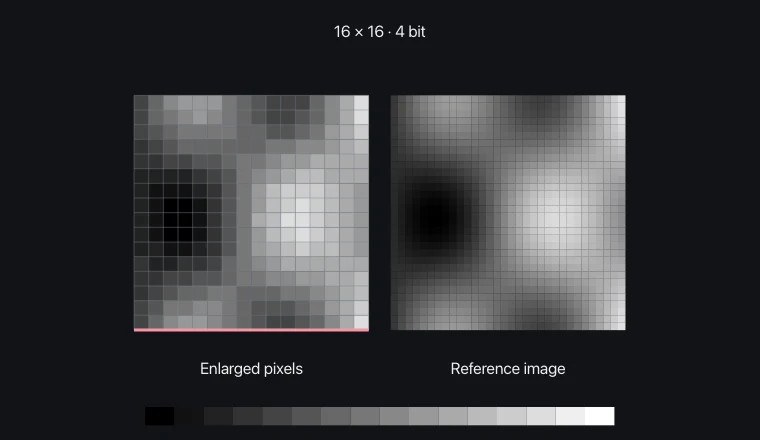
Pixels, bit depth, and image size
Pixel count represents the number of spatial samples, and bit depth is related to the number of steps in a single pixel value. File size depends on both of these conditions.
Read the concept →Networks and security

Packet transmission and retransmission
If the message is divided into packets, each can be transmitted and then reassembled. When loss is compensated for by retransmission, both the completion rate and the delay change.
Read the concept →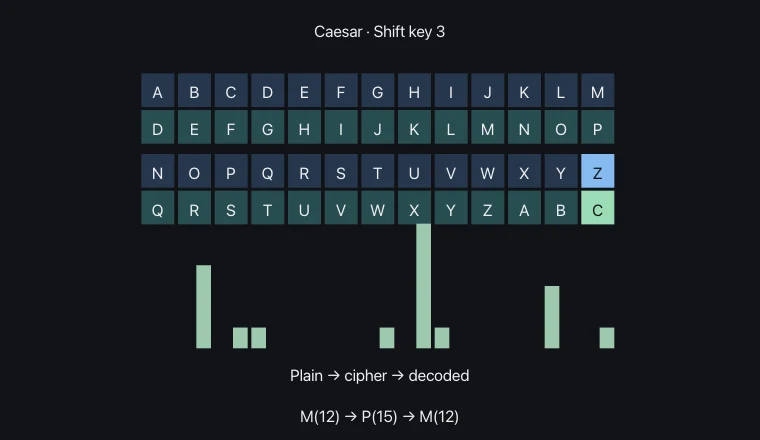
Substitution ciphers and public-key cryptography
Encryption maps plaintext to ciphertext using a specified key. Public-key systems can assign encryption and decryption to different keys.
Read the concept →AI foundations
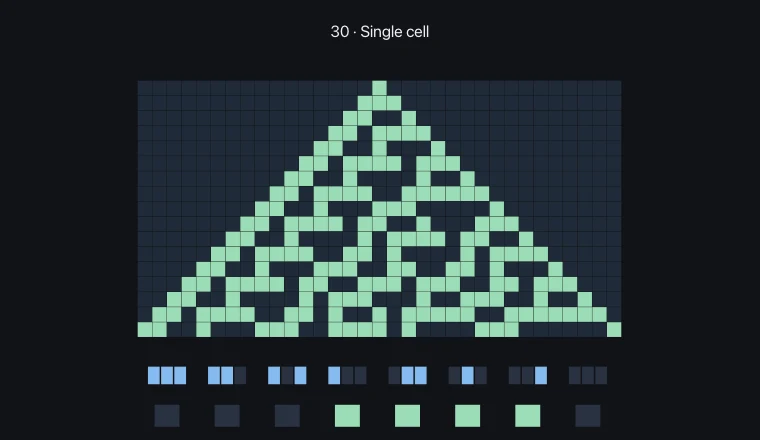
Cellular automata and local rules
Cell automata update the state of each cell based on its neighboring states and predefined rules. Even with simple rules, complex overall patterns can emerge.
Read the concept →
Perceptrons and linear classification
A perceptron divides data into two categories based on the weighted sum of inputs and bias. Data that cannot be perfectly separated using a single-layer linear classifier cannot be divided by a straight line.
Read the concept →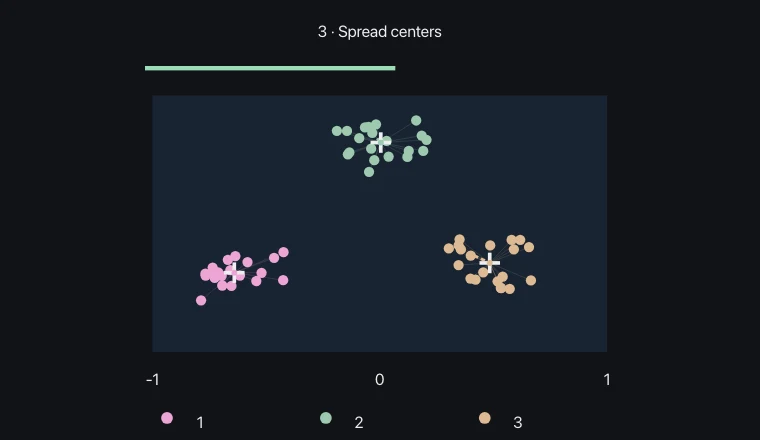
k-means clustering and sum of squared errors
k-means repeatedly assigns points to the nearest center and moves each center to its assigned points’ mean. Clustering differs from classification trained on known labels.
Read the concept →