
CONCEPTS / PHYSICS
Physics concepts
Explore the principles, key relationships, examples, and model limits in physics, then test them in related experiments. These 24 concepts connect to 20 experiments.
All physics experiments →Mechanics

Free fall and gravitational acceleration
Free fall is motion under gravity alone, neglecting forces such as air resistance. Near Earth’s surface, objects of different masses undergo the same gravitational acceleration.
Read the concept →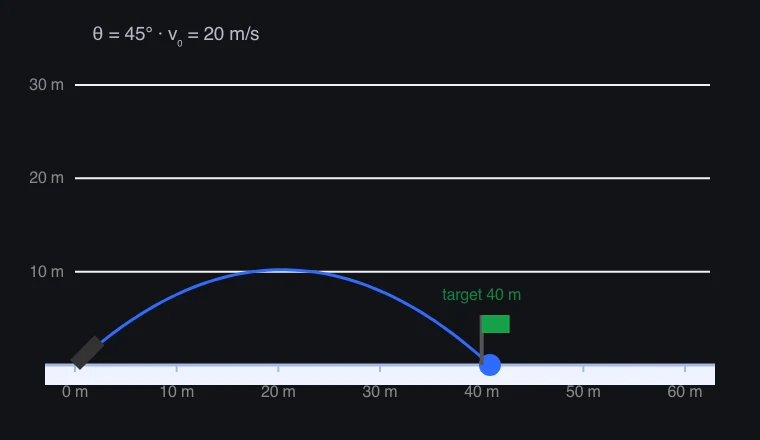
Projectile motion
Projectile motion is the movement of an object that has been thrown, under the influence of gravity. If we ignore air resistance, the horizontal speed remains constant, while the vertical speed continuously changes due to gravity.
Read the concept →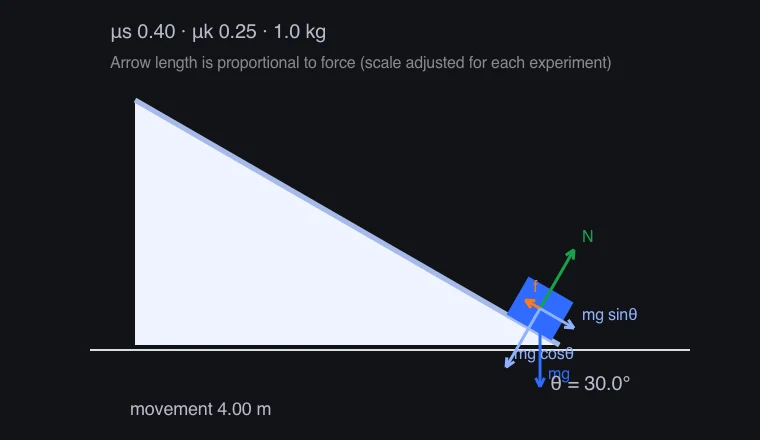
Static and kinetic friction
Friction is the force that prevents the relative sliding of two contacting surfaces. The static friction, which occurs when there is no sliding yet, and the kinetic friction, which occurs when sliding has already begun, are calculated differently.
Read the concept →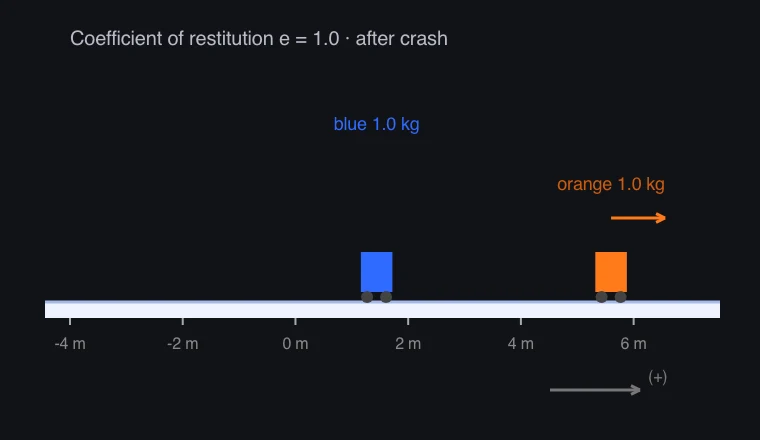
Conservation of momentum and collisions
Momentum is a physical quantity that is the product of mass and velocity, with a specific direction. If we consider the two colliding objects as a single system and ignore any external impact forces, the total momentum is conserved.
Read the concept →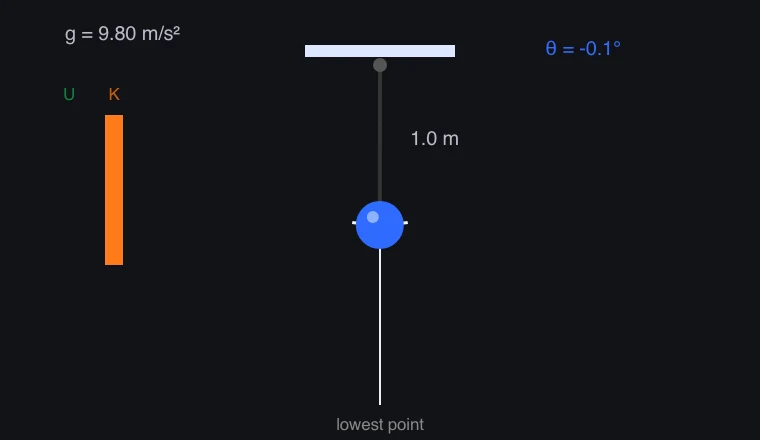
Pendulum period and the small-angle approximation
A simple pendulum is an ideal pendulum with its mass concentrated in a point bob suspended from a light, inextensible string. At small angles, its period is determined by string length and gravitational acceleration.
Read the concept →Energy conservation and energy conversion
Energy conservation means that the total energy balance holds as energy changes form or crosses a system boundary. Keeping the sum of kinetic and potential energy alone constant requires additional conditions.
Read the concept →Waves and sound

Waves, wavelength, and frequency
Waves are phenomena where vibrations or disturbances are transmitted through space. In the case of waves on a string, the shape and energy are transmitted laterally while the particles of the string vibrate near their original positions.
Read the concept →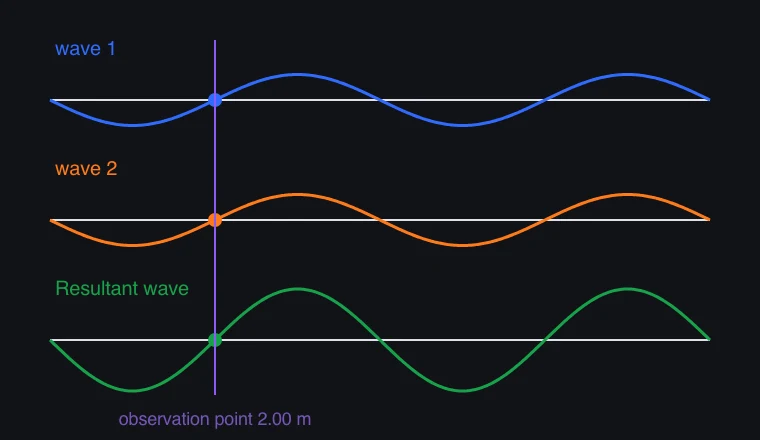
Wave superposition and interference
When two waves overlap in a linear medium, the displacement at a specific point is the sum of the displacements created by each wave individually. This phenomenon of waves increasing or decreasing due to this superposition is called interference.
Read the concept →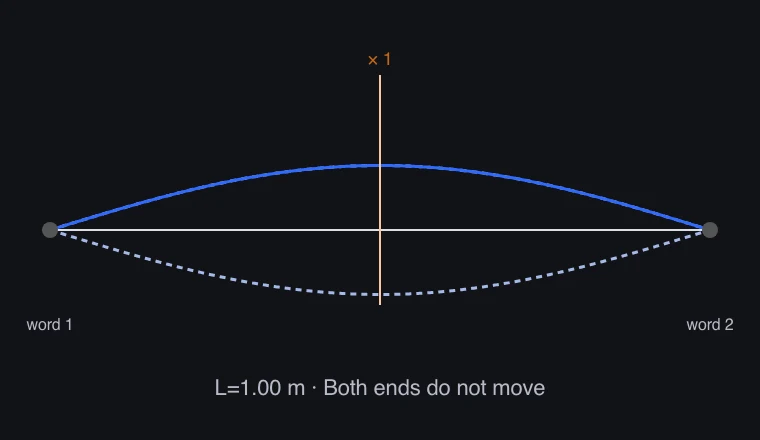
Standing waves, nodes, and antinodes
A standing wave forms when waves with the same frequency and amplitude travel in opposite directions and overlap, producing a fixed spatial pattern of amplitude. It has stationary nodes and antinodes with the greatest oscillation amplitude.
Read the concept →Resonance and damping
Resonance is an enhanced oscillatory response near a particular frequency under periodic external driving. Its size depends on natural frequency, damping, and how the system is driven.
Read the concept →Electricity and magnetism
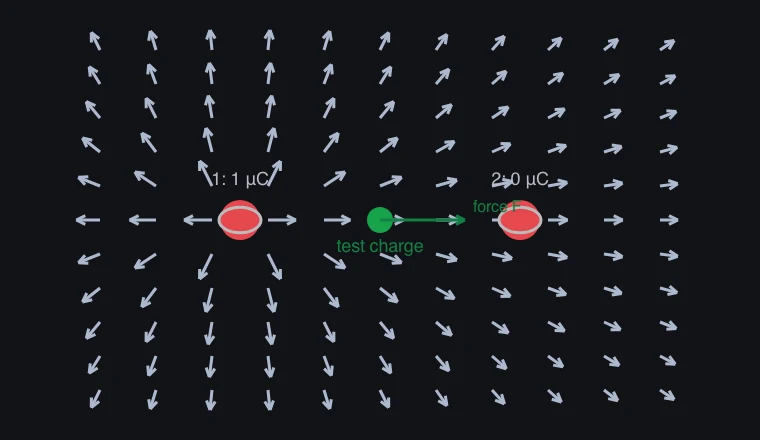
Electric charge and electric fields
The electric field is a vector that represents the force exerted on a small, test charge, given the amount of charge and the position of that charge; it indicates how much force, per unit of charge, is exerted on the test charge, and in what direction. It is necessary to distinguish between the charge creating the field and the test charge receiving the force.
Read the concept →
Electrical resistance and resistivity
Electrical resistance indicates the degree to which a current finds it difficult to flow. When a constant voltage is applied, a smaller current indicates a larger resistance. Furthermore, the resistance of a uniform wire depends not only on the material but also on its length and cross-sectional area.
Read the concept →Ohm’s law, voltage, and current
Ohm's law states that in a constant resistance, Ohm-compliant conductor with fixed temperature and physical conditions, the voltage and current are proportional to each other. If the voltage is increased while maintaining a constant resistance, the current will also increase at the same ratio.
Read the concept →
Series and parallel circuits
Series connections create a single path through which current flows, while parallel connections establish multiple paths between two points. It is important to examine what points are actually connected, rather than relying solely on the visual representation.
Read the concept →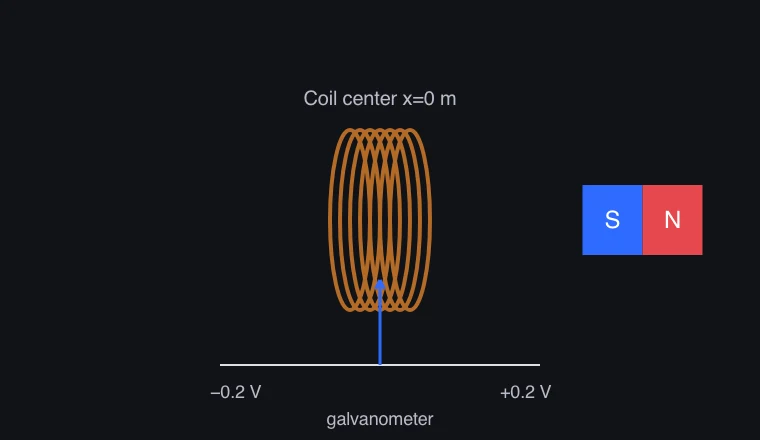
Electromagnetic induction and Lenz’s law
Electromagnetic induction produces an electromotive force when the magnetic flux through a circuit changes. What matters is how the flux through the coil changes over time, rather than merely whether a magnet is nearby.
Read the concept →Optics
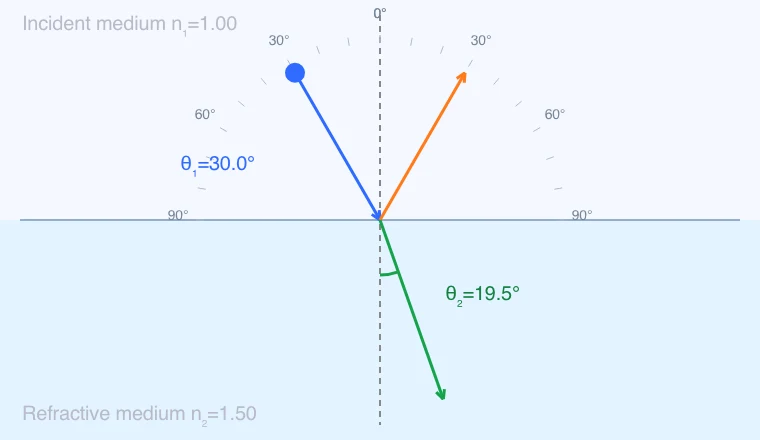
Refraction and refractive index
Refraction is the phenomenon where the direction of light changes when it passes through the boundary between two different mediums. Refractive index is defined as the ratio of the speed of light in a vacuum to the phase speed of light in the corresponding medium.
Read the concept →Total internal reflection and the critical angle
Total internal reflection occurs when light passes from a medium with a high refractive index to a medium with a lower refractive index, and when the incidence angle is greater than the critical angle. In an ideal, loss-free boundary, light is reflected rather than refracted when there is no propagating refracted light.
Read the concept →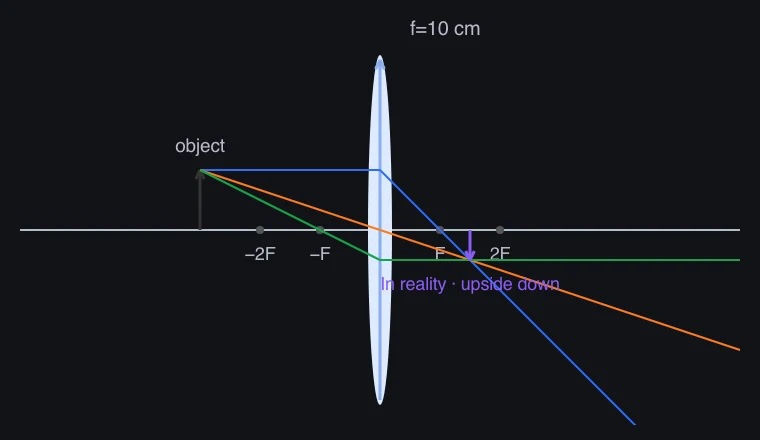
Real and virtual images in a convex lens
Convex lenses are lenses that typically gather parallel light rays from air. When an object is located outside the focal point, a real image is formed, and when it is located inside the focal point, a virtual image is formed, which differs in direction and size compared to the original object.
Read the concept →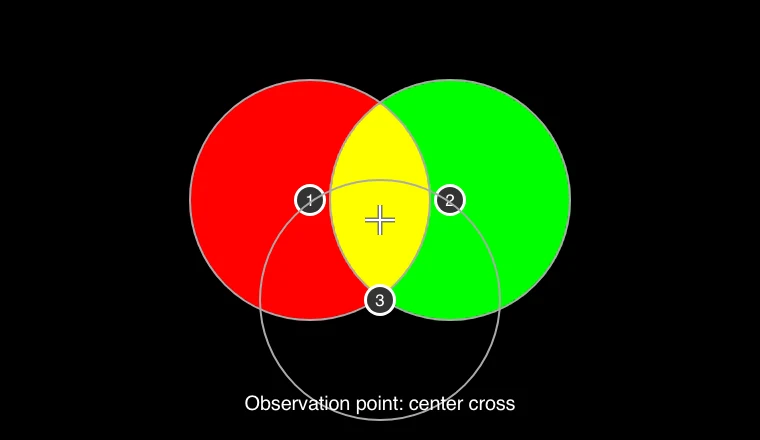
Additive and subtractive color mixing
Additive mixing combines light, while subtractive mixing absorbs selected light. Distinguish overlapping RGB light on a screen from overlapping ideal CMY filters.
Read the concept →Heat and gases
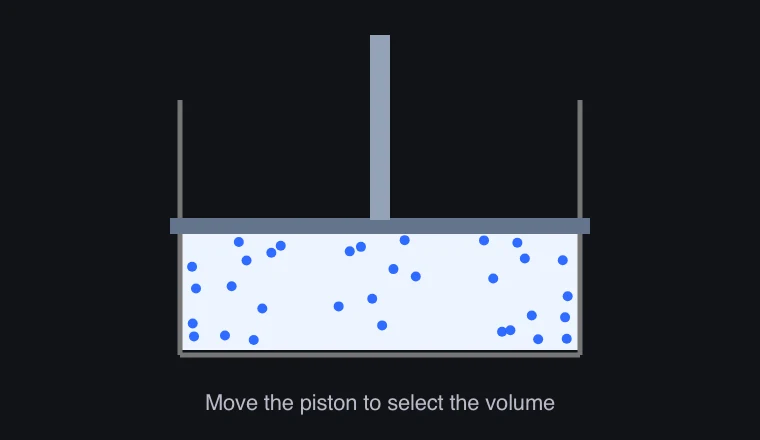
Boyle’s law and ideal gases
Boyle’s law relates pressure and volume inversely for a fixed amount of gas at constant temperature. Changing temperature or the amount of gas does not preserve the same PV value.
Read the concept →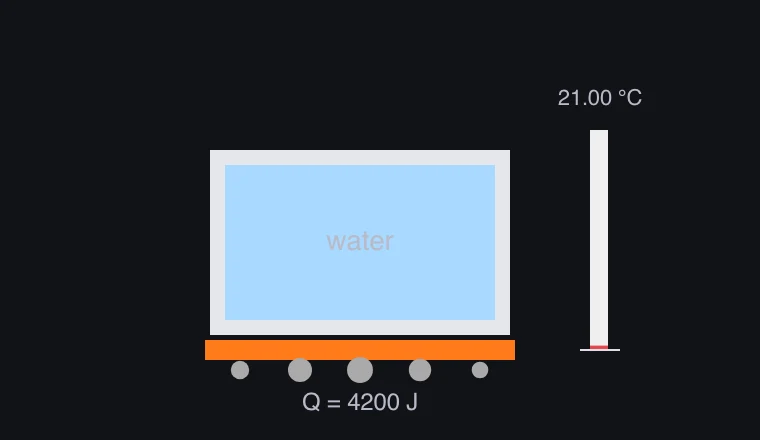
Specific heat, heat transfer, and temperature change
Specific heat is the energy required to raise the temperature of unit mass of a substance by 1 K. With the same heat input, different specific heats or masses produce different temperature changes.
Read the concept →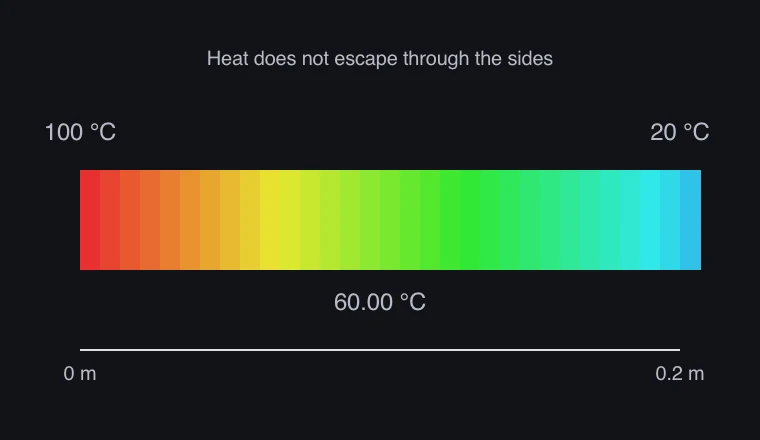
Heat conduction and thermal diffusivity
Heat conduction transfers energy because of temperature differences without bulk movement of the material. Energy moves from hotter to colder regions, changing the temperature distribution over time.
Read the concept →Modern physics
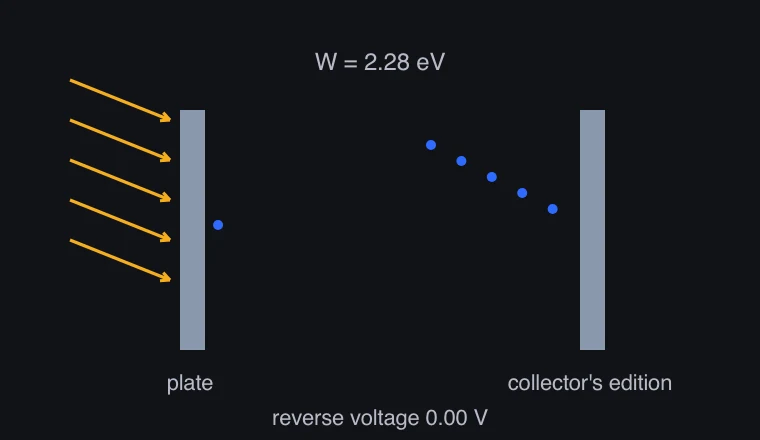
The photoelectric effect and photons
The photoelectric effect is the phenomenon of electrons being emitted from a metal surface when it is exposed to light. In the conventional single-photon model, a single photon must possess sufficient energy; therefore, increasing the brightness of light and increasing the frequency are distinct processes.
Read the concept →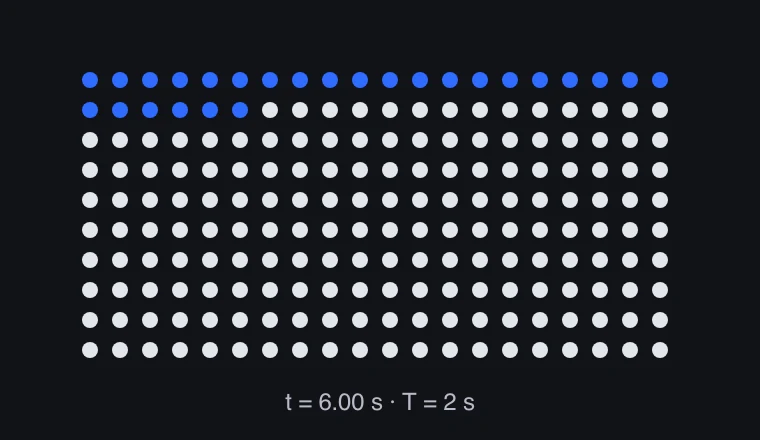
Radioactive decay and half-life
Radioactive decay is a probabilistic process in which unstable atomic nuclei transform into different states or different types of nuclei. While the timing of the decay of an individual nucleus cannot be predicted, the average decrease of a large number of nuclei of the same type follows a definite law.
Read the concept →