
CONCEPTS / ELECTRONICS
Electronics concepts
Explore the principles, key relationships, examples, and model limits in electronics, then test them in related experiments. These 30 concepts connect to 30 experiments.
All electronics experiments →Electricity and magnetism

DC circuits

Voltage dividers and loading effects
The mid-voltage of a series resistor is determined by the resistance ratio, but when a load is connected to the output, this ratio changes.
Read the concept →
Kirchhoff’s current and voltage laws
At a node, the inflow and outflow of current are equal, and in an ideal circuit’s closed loop, the sum of voltage changes is 0.
Read the concept →
Battery EMF and internal resistance
A real source can have an internal voltage drop while supplying current. Distinguish its EMF from the terminal voltage measured under load.
Read the concept →
Wheatstone bridge balance
A bridge is balanced when its two middle nodes have equal potential and the galvanometer current is 0. This condition can be used to determine an unknown resistance.
Read the concept →
Electrical power, Joule heating, and fuses
Resistance converts electrical energy into heat. The resulting difference in heat generation depends on whether you fix the current or the resistance.
Read the concept →Capacitors and coils

Charging and discharging an RC circuit
When charging a capacitor through a resistor, the voltage does not immediately equal the source voltage. The RC time constant determines the scale of the change.
Read the concept →
Parallel-plate capacitors and stored energy
Capacitance depends on geometry and dielectric material. Different quantities remain fixed when the capacitor is connected to a battery and when it is disconnected.
Read the concept →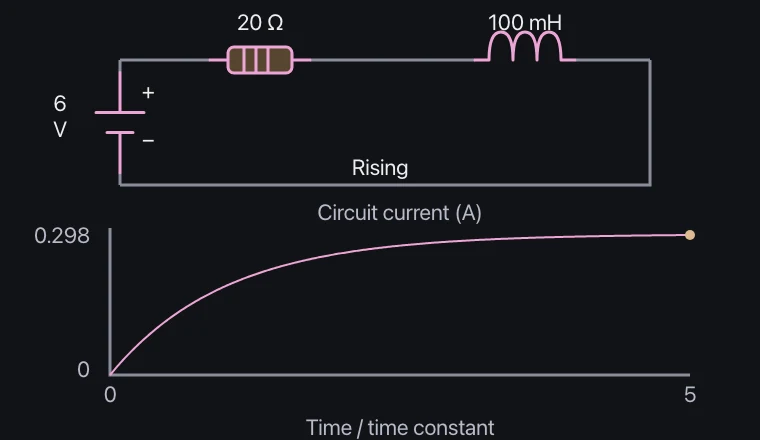
RL circuits and self-induction
The self-inductance of a coil acts in a direction that opposes changes in current. Even when a specific voltage is applied, the current does not immediately reach its final value.
Read the concept →
Electromagnets and magnetic saturation
A coil’s magnetic field depends on current and the number of turns. An iron core can strengthen the field substantially, but the field does not grow proportionally without limit.
Read the concept →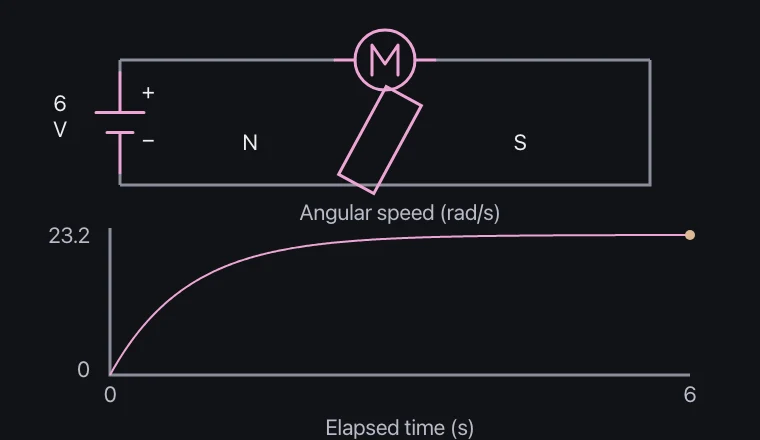
DC motors and back EMF
A direct current motor converts the interaction between current and a magnetic field into rotation. When the rotation speed increases, the back EMF affects both the current and the torque.
Read the concept →AC and power

Oscilloscopes and waveform measurements
An oscilloscope displays the change in voltage over time. The scale setting alters the size of the waveform being displayed, but does not change the actual frequency of the signal.
Read the concept →
AC RMS values and average power
The RMS value of an AC signal equals the DC value producing the same average heating in a resistor. The simple mean voltage differs from the square root of its mean square.
Read the concept →
Series RLC resonance and impedance
In a series RLC circuit, the reactances of the coil and capacitor cancel each other at a specific frequency. We will examine the conditions under which the current increases with a constant voltage.
Read the concept →
Transformers and turns ratio
The transformer connects two coils using a changing magnetic flux. In an ideal scenario, the voltage follows the turns ratio, and the current changes according to the power relationship.
Read the concept →
Transmission voltage and line losses
When sending the same power, increasing the voltage will reduce the current. The losses in a resistive circuit are proportional to the square of the current.
Read the concept →Semiconductor devices
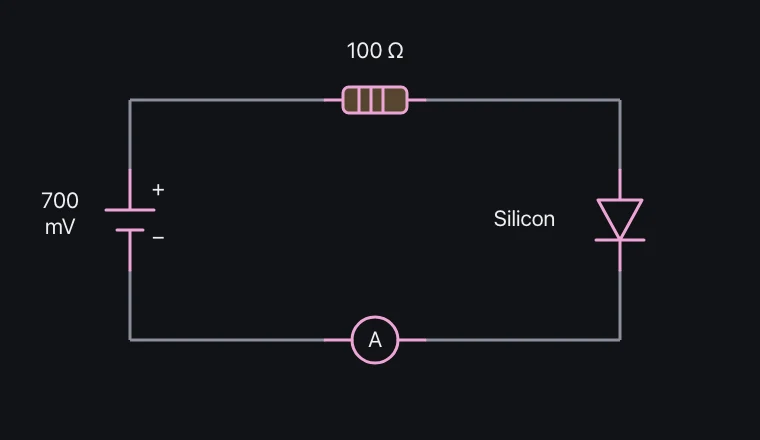
Nonlinear diode current–voltage characteristics
The current in a diode does not simply scale linearly with voltage. As the forward voltage increases, the current can increase dramatically, making a series resistor important.
Read the concept →
LED colors and photon energy
When the frequency of light increases, the energy of a single photon becomes larger. If this is connected to the threshold voltage of an LED, it can be used to approximately estimate Planck's constant.
Read the concept →
Rectification and smoothing circuits
Rectification converts alternating current into one direction, and smoothing reduces fluctuations in the output. However, rectification alone does not produce a completely constant direct current.
Read the concept →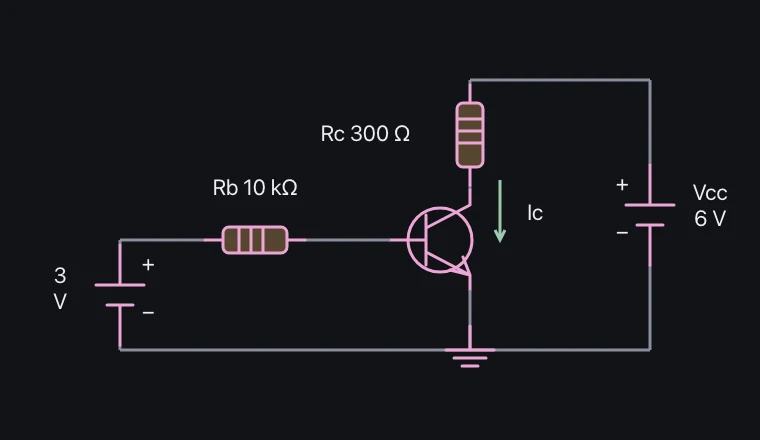
Transistor switching
An NPN transistor can control the load current with a small base current. In the amplification region, the current ratio does not continue directly until saturation.
Read the concept →
Transistor amplification and clipping
The amplifier responds to small changes in the input by converting them into a larger output change using the power of the power supply. If the input becomes too large, the waveform can be cut off.
Read the concept →Digital logic and control
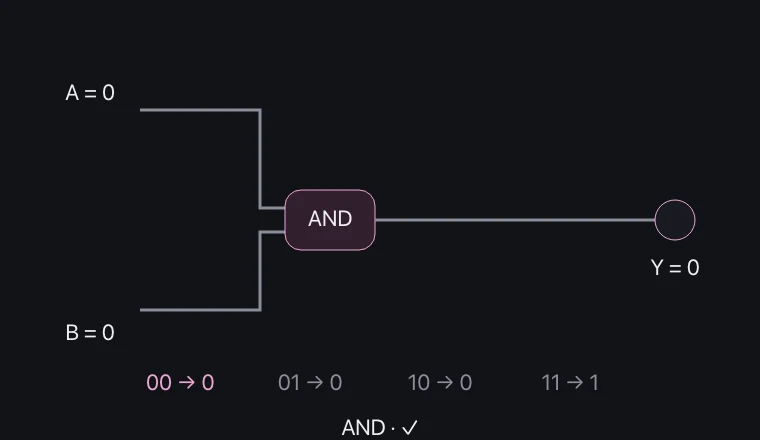
Logic gates and truth tables
Logic gates map input values 0 and 1 to an output according to a predetermined rule. A truth table is a table used to exhaustively compare all possible input combinations.
Read the concept →
Binary adders and carry bits
Binary addition calculates the sum of the current digit and the carry-over to the next digit simultaneously. It can be implemented using a combination of logic gates.
Read the concept →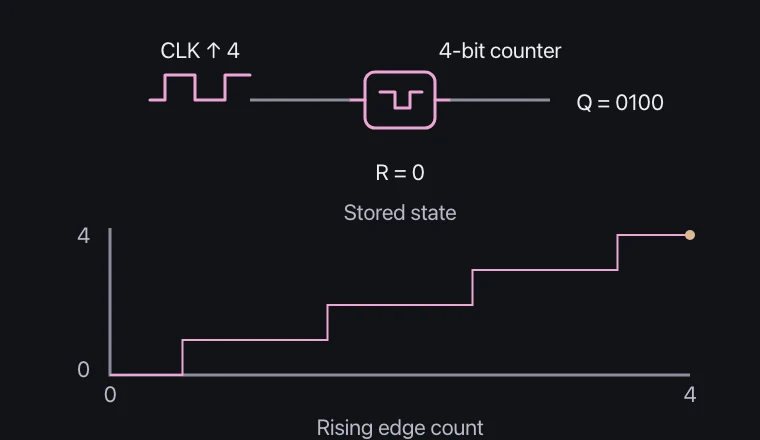
Flip-flops and digital state storage
The flip-flop is a sequential logic circuit that stores the previous state. A D flip-flop receives input and updates its output state at a defined clock edge.
Read the concept →
Sampling, quantization, and aliasing
Sampling determines time intervals, while quantization defines value steps. Sampling frequency and ADC bit-count influence different types of information loss.
Read the concept →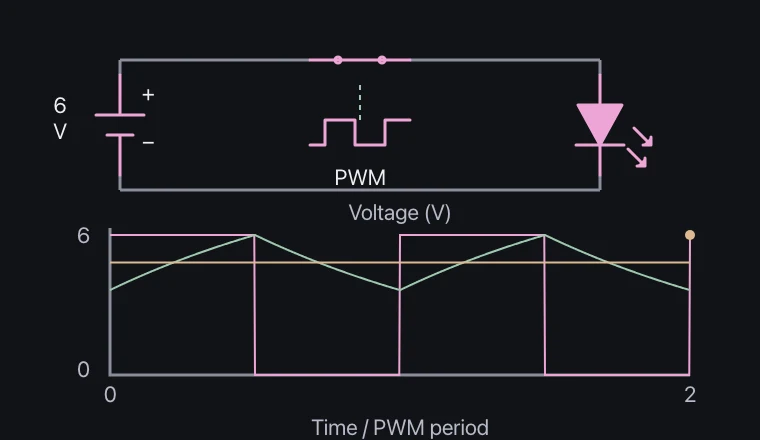
PWM and duty cycle
PWM controls the average driving level based on the ratio of time it is turned on. Even with the same duty cycle, the movement will differ depending on how quickly the target responds.
Read the concept →Sensors and analog signals

Photoresistors and threshold control
Changes in a photoresistor’s resistance can be measured as voltage changes in a voltage divider. Depending on the arrangement of the resistors, the output may increase or decrease as illumination increases.
Read the concept →
NTC thermistors and temperature measurement
The NTC thermistor’s resistance decreases as the temperature increases. Because it uses a non-linear curve, it differs from simple linear markings.
Read the concept →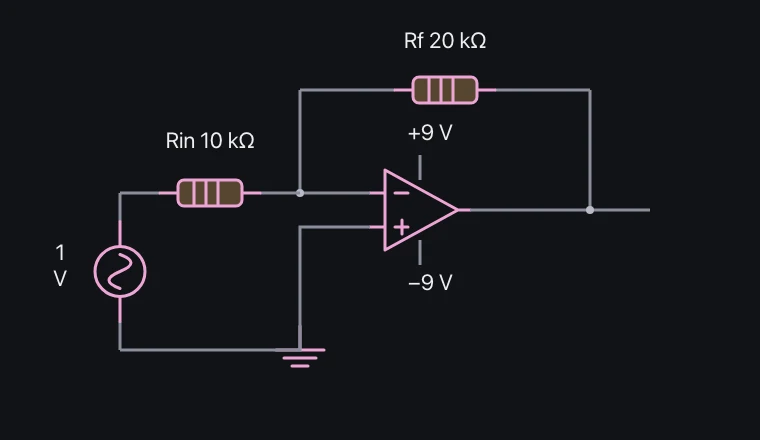
Operational amplifiers and negative feedback
Negative feedback allows an operational amplifier’s closed-loop gain to be set by resistor ratios. Its output remains limited by the supply voltage range.
Read the concept →
RC filter frequency response
RC filters modify both the magnitude and phase of a signal differently depending on the frequency. The cutoff frequency is not the point at which the signal completely disappears.
Read the concept →