
Meaning and mechanism
Buoyancy is the net upward force produced by fluid pressure changing with depth. Its magnitude equals the weight of the displaced fluid.
A hollow vessel occupies a larger volume relative to its total mass, allowing it to displace the necessary amount of water. It is necessary to differentiate between the density of the metal itself and the average density of the entire vessel.
Relationships and conditions
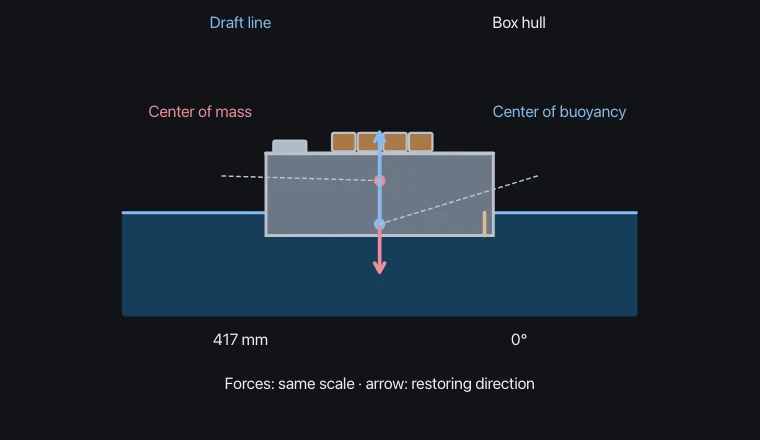
Fb=ρgV_displaced. In a model with constant waterplane area, the draft is d=m/(ρAwp), so a larger mass sinks deeper when the area is unchanged.
In a real hull, waterplane area varies with depth. Draft, stability against capsizing, waves, and water ingress are separate considerations.
What to observe in the simulation
While floating, buoyancy equals hull and cargo weight.
A box hull has mass 2000 kg and depth 1.5 m. Level hydrostatic draft and small-angle metacentric heel are calculated separately. Large heel, negative stability and sinking dynamics are invalid. Do not reproduce ship loading tests.
Key relationships and symbols
d = m/(ρAwp) · Fb = ρgVdisplaced
| Symbol | Meaning | Unit |
|---|---|---|
| V_displaced | Volume of water displaced by the hull | m³ |
| Awp | Waterplane area | m² |
| d | Draft | m |
Worked example
At equal mass, how does sea-water draft compare?
Slightly shallower · While floating, buoyancy equals hull and cargo weight.
Common misconceptions
- It is not appropriate to explain that the reason a container floats is because the density of the metal used to make the container is smaller than that of water.