
Meaning and mechanism
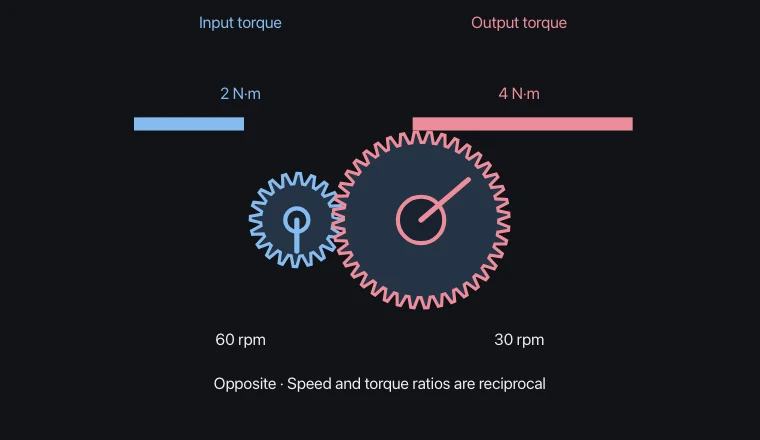
When gears mesh without slipping and engage, the speed of the tangent at the contact point is the same. Because a larger gear passes over more teeth per revolution, it can rotate more slowly than a smaller gear.
A pair of meshing gears rotate in opposite directions. When multiple stages are connected, the speed ratio between each stage is multiplied, and the alignment of the rotation is determined based on the degree of meshing.
Relationships and conditions
In a pair, |ωout/ωin|=Nin/Nout|. In lossless, normal transmission, the torque multiplied by angular velocity is equal, resulting in an increase in output torque proportional to the deceleration ratio.
Real gears have friction, backlash, and a limit of torque. Unlike a simple intermediate idler gear, which has a different way of contributing to the overall force.
What to observe in the simulation
Reducing speed increases torque while ideal shaft power stays equal.
External gears have no slip or friction. Two stages form a compound train with the same tooth ratio per stage. Rotation is slowed for observation.
Key relationships and symbols
ωout/ωin = (Nin/Nout)ⁿ · Tout/Tin = 1/|ωout/ωin|
| Symbol | Meaning | Unit |
|---|---|---|
| N | Number of gear teeth | items |
| ω | Angular velocity | rad/s |
| T | Transmitted torque | N·m |
Worked example
How does torque change in a reduction gear?
It gets bigger · Reducing speed increases torque while ideal shaft power stays equal.
Common misconceptions
- It is not possible to obtain a greater driving force than the input by increasing both speed and torque with the gear.