
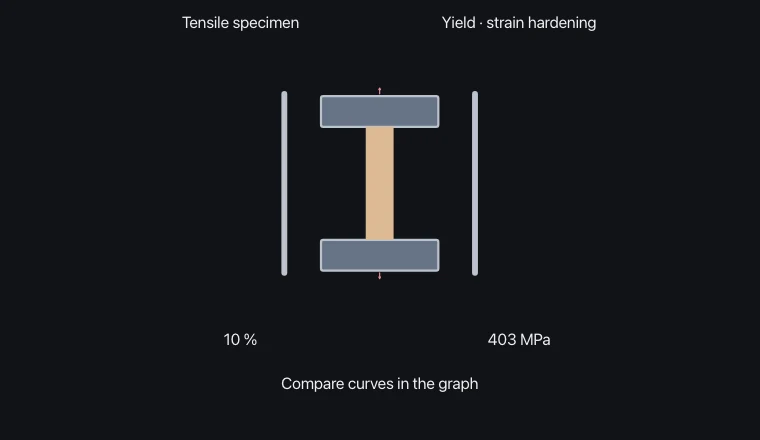
Meaning and mechanism
Even if the force is the same, a smaller cross-section results in a greater stress. Even if the amount of stretching is the same, a longer original length results in a smaller relative strain.
In the linear elastic region, when the load is removed, the tendency is to return to the original length. However, after the yield point, permanent deformation occurs, and if sufficiently deformed, it can lead to fracture.
Relationships and conditions
The stated nominal stress σ=F/A₀ and nominal strain ε=ΔL/L₀ are σ=Eε in a linear segment. At this point, the slope E represents the Young’s modulus.
In large deformations, the actual cross-section and length change, resulting in differences between the true stress and the yield stress. This affects the specimen shape and deformation rate, as well as the results obtained from material modeling.
What to observe in the simulation
The elastic stress–strain slope is Young modulus.
Piecewise engineering stress uses representative constants. Wood is simplified with a ductile comparison curve. Rate only changes reached strain; rate dependence is omitted. Do not reproduce fracture tests.
Key relationships and symbols
σ = Eε (elastic) · F = σA · ε = rate × t
| Symbol | Meaning | Unit |
|---|---|---|
| σ | Engineering stress | Pa |
| ε | Engineering strain | Dimensionless |
| E | Elastic modulus | Pa |
Worked example
At equal stress, what happens to force with larger area?
It gets bigger · The elastic stress–strain slope is Young modulus.
Common misconceptions
- It is not possible to apply the linear equation for the elastic region directly, even after yielding and fracture.