
Meaning and mechanism
The center of gravity is the position that represents the sum of gravitational forces as a single point. The support area is an area created by the points where it contacts the ground.
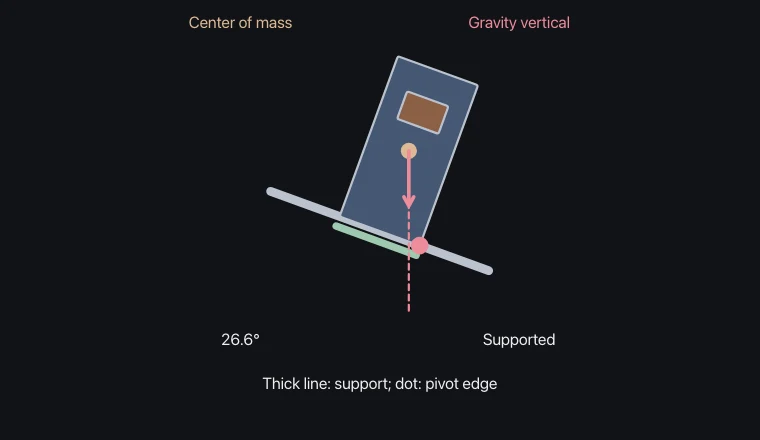
When an object is tilted, the line of action of the force of gravity approaches the edge of the support area. If this edge is exceeded, a moment of rotation can arise in the direction of the fall.
Relationships and conditions
In the experimental model using rigid bodies, the tanθc=(b/2−offset)/hcg value is used. A wider support and a lower center of gravity result in a greater margin of safety against tipping.
This is an assessment of whether the material is semi-rigid and whether a defined contact condition is met. If there is slip, impact, deformation, or moving internal mass, the actual behavior will differ.
What to observe in the simulation
Tipping starts when the vertical mass-center projection leaves the support.
A rigid block does not slide. Post-tipping rotation is an illustrative interpolation, not impact analysis. Do not tilt heavy real objects.
Key relationships and symbols
tan θc = (b/2 − offset)/hcg
| Symbol | Meaning | Unit |
|---|---|---|
| b | Support width | m |
| hcg | Mass center height | m |
| offset | Horizontal offset from the center | m |
Worked example
What determines tipping?
Gravity line and support area · Tipping starts when the vertical mass-center projection leaves the support.
Common misconceptions
- The fact that the center of gravity is high is not sufficient to disregard the span and position of support, and to determine stability.