
Meaning and mechanism
A saturated solution is a solution that has reached its limit, meaning it can dissolve no more of a solute at a given temperature. When a solid is present, dissolution and precipitation can dynamically balance.
When solubility is expressed as solute mass per 100 g of water, the maximum dissolved mass scales with the amount of water. Doubling the water doubles the maximum dissolved mass at the same temperature.
Relationships and conditions
If the solubility S is expressed as g/liter 100 g, the maximum solubility is S × water mass / 100. If the amount added exceeds this, a portion will remain as a solid.
Solid solubilities tend to increase with temperature; however, this trend does not apply to all substances. It is important to differentiate between the rate at which a solid reaches equilibrium and the final solubility achieved.
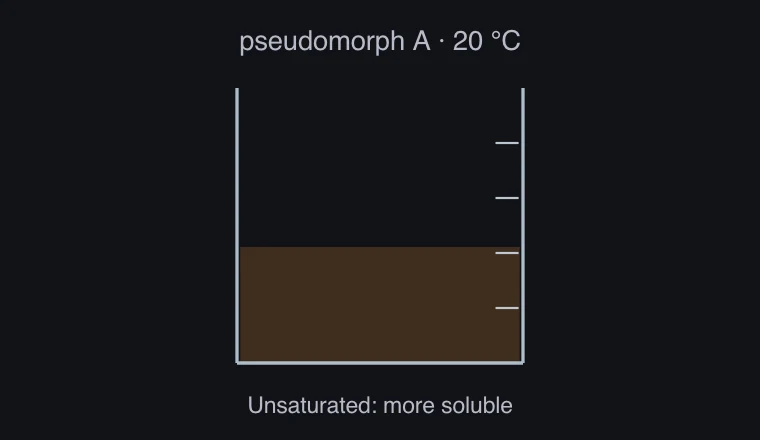
What to observe in the simulation
The dissolved amount is the smaller of the added amount and the maximum dissolved amount. Saturation is when the limit of solubility has been reached and no solids necessarily remain.
This is an educational table of virtual substances A and B. This is not actual reagent data. Assuming 0~100 °C, 1 atm, the unit is g/100 g of water, and linear interpolation is performed between sections. Equilibrium is reached immediately and the water does not evaporate. Melting speed, supersaturation, heat of dissolution, and solution volume are not calculated.
Key relationships and symbols
Maximum dissolution amount = S(T) × mass of water / 100
| Symbol | Meaning | Unit |
|---|---|---|
| S(T) | Solubility per 100 g of water at temperature T | g |
| m_water | Mass of water | g |
Worked example
What happens if you add more solute to a saturated solution at the same temperature?
If the temperature and mass of water are the same, the melting limit is the same. Solutes that exceed the limit remain as solids.
Common misconceptions
- It is not the case that a solute does not dissolve at all in a solution when a solid remains on the bottom.