
Meaning and mechanism
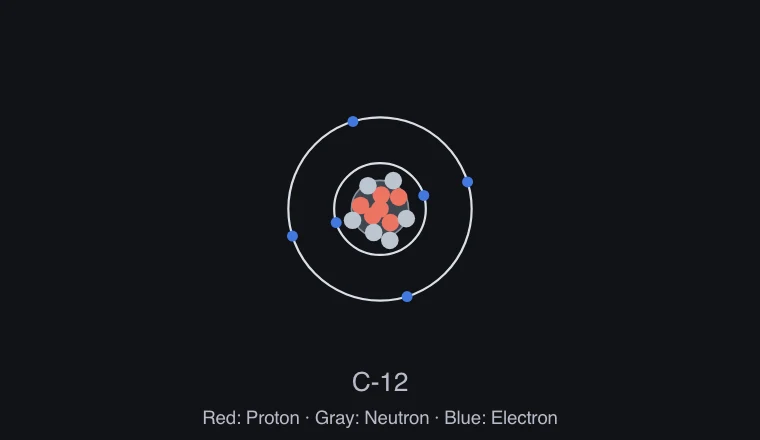
The atomic nucleus contains protons and neutrons, and electrons exist around it. Since the atomic number Z corresponds to the number of protons, losing electrons will not change the type of element.
Atoms of the same element with different numbers of neutrons are called isotopes. Carbon-12 and Carbon-14 have the same number of protons (6), but their neutrons are respectively 6 and 8.
Relationships and conditions
Mass number A represents the sum of the number of protons and the number of neutrons. It is obtained by subtracting the number of electrons from the number of protons.
Atomic mass number is an integer representing the number of nucleons. It is not equal to the actual atomic mass, which reflects the binding energy and the existence of isotopes, or the average atomic mass found in the periodic table.
What to observe in the simulation
Neutrons change isotopes, and electrons change ion charges. Elements are determined by the number of protons.
It's a particle counting model. The electron shell is an introductory schematic diagram and is not the actual circular orbit of an electron. Nucleus size and particle size are not proportional. Nuclear stability, decay, and electron configuration energies are not calculated.
Key relationships and symbols
Z = p · A = p + n · Charge = p − e
| Symbol | Meaning | Unit |
|---|---|---|
| Z | Proton number; atomic number | Dimensionless |
| A | Number of protons + number of neutrons | Dimensionless |
| p, n, e | Numbers of protons, neutrons, and electrons | items |
Worked example
Why are C-12 and C-14 the same element?
Elements are determined by the number of protons. Isotopes have the same number of protons but different numbers of neutrons.
Common misconceptions
- The fact that the number of neutrons has changed does not mean that the element has changed. The criterion for distinguishing an element is the number of protons.