
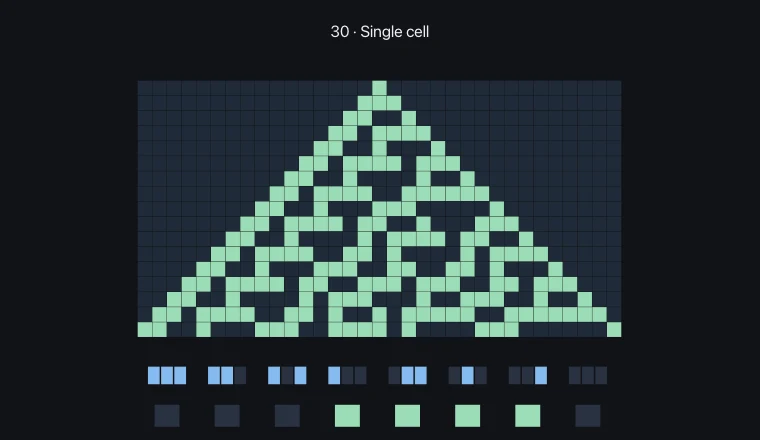
Meaning and mechanism
Each cell in the grid has a finite state, and the next visual state is determined by the current state of its surroundings. Typically, all cells in a single generation are calculated simultaneously from the same previous generation.
Even if the rules are the same, a different pattern emerges when the initial state is different. This changes the long-term changes in the pattern regarding whether or not the grid is connected to 0 on one side or the other.
Relationships and conditions
The three neighbors in a one-dimensional binary model have 8 possible input combinations; the rule number specifies the next state for each. Life’s B3/S23 specifies the neighbor counts for birth and survival.
If you immediately overwrite the cells in sequence, it results in a different outcome compared to simultaneous updating. It does not expand the effect of a finite grid into the general properties of an infinite space.
What to observe in the simulation
One rule can generate different patterns from different initial states.
1D boundaries are zero; Life uses a 16×16 torus. Finite boundaries affect long-term patterns.
Key relationships and symbols
next = (rule >> (4L + 2C + R)) & 1 · Life B3/S23
| Symbol | Meaning | Unit |
|---|---|---|
| L, C, R | Previous states of the left, current, and right cells | 0 or 1 |
| B3/S23 | Born in 3 neighborhood, survived in 2·3 neighborhood. | Update rule |
Worked example
What does a Life glider do after four generations?
One diagonal cell · One rule can generate different patterns from different initial states.
Common misconceptions
- The name “cellular” does not mean that the model calculates every process in a real biological cell.