
Meaning and mechanism
Higher albedo means a smaller fraction of the same incoming solar radiation is absorbed. Radiative equilibrium occurs when the incoming and outgoing radiative energy rates are equal.
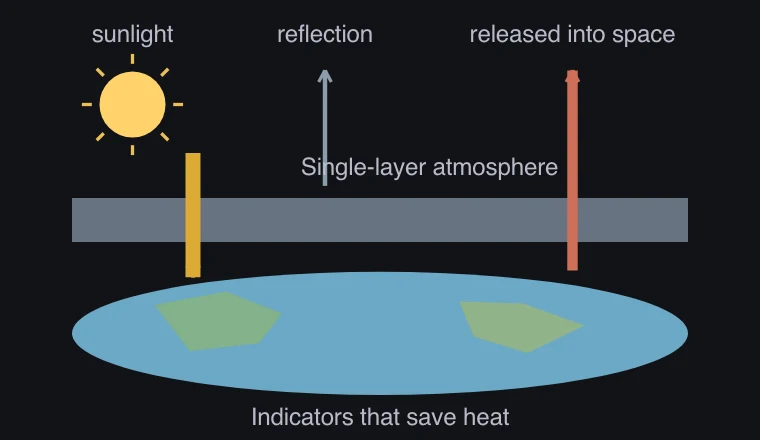
The atmosphere can absorb infrared radiation from a surface, and then re-emit it in both upward and downward directions. When maintaining a constant outgoing radiation, the surface’s equilibrium temperature can increase.
Relationships and conditions
For a spherical blackbody without an atmosphere, Te=[S(1−α)/(4σ)]¼. The factor 4 comes from the ratio between the sunlight-intercepting cross-sectional area and the sphere’s full surface area.
The one-layer atmosphere model omits clouds, convection, and water-vapor feedback. Its infrared absorption coefficient must not be equated directly with a particular CO₂ concentration or actual climate sensitivity.
What to observe in the simulation
If the reflectivity is high, the absorbed solar radiation is reduced. When the atmosphere absorbs and re-emits infrared rays, the equilibrium surface temperature increases.
It is a radiation balance model of the first layer of the atmosphere, which absorbs only infrared rays. The atmosphere is at instantaneous radiation equilibrium, and the surface is at constant heat capacity, which is integrated by RK4. ε does not correspond to a specific CO₂ concentration. Cloud, convection, water vapor feedbacks and actual climate predictions are excluded.
Key relationships and symbols
Te=[S(1−α)/(4σ)]¼ · Ts=Te·[2/(2−ε)]¼
| Symbol | Meaning | Unit |
|---|---|---|
| α | Planetary albedo | 0~1 |
| S | Solar radiation power | W/m² |
| σ | Stefan–Boltzmann constant | W/(m²·K⁴) |
Worked example
If only heat capacity increases, what happens to the equilibrium temperature after enough time?
Equilibrium is when the absorbed solar radiation and the long-wave radiation going out into space are equal. C only changes dT/dt, so it does not change the final temperature.
Common misconceptions
- The greenhouse effect does not mean that the atmosphere is creating energy anew.