
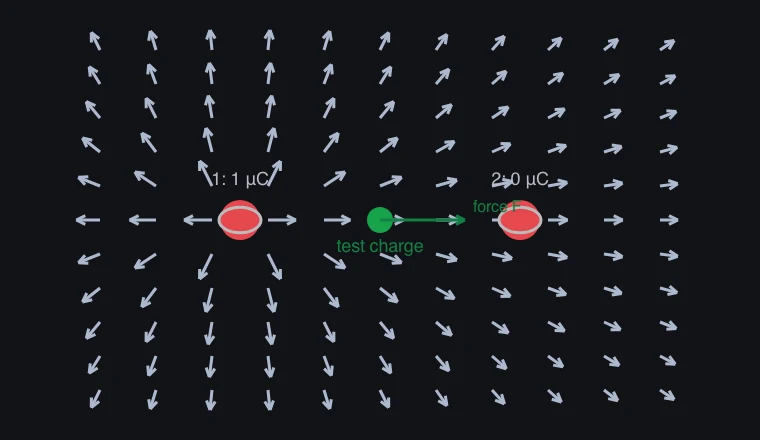
How do electric fields differ from electric forces?
The electric field E is defined at every position in space, and the electric force acting on a test charge q is F = qE. A positive test charge experiences a force in the same direction as the electric field, while a negative test charge experiences a force in the opposite direction. Changing the sign of the test charge does not alter the original electric field direction itself.
We assume that the initial charge transmitted is small enough not to change its arrangement. When defining an electric field, it is not necessary for every point in space to have a charge. Once the position and size of the charges creating the field are determined, we can calculate the field at points where there is no transmitted charge.
As the distance increases from the point of charge, how much will it weaken?
The electric field strength of a point charge Q isolated in a vacuum is E = k|Q|/r². If the distance is doubled, the strength becomes ¼ of its original value. For a positive charge, the electric field lines point outward; for a negative charge, they point inward. The electric field lines are a visual tool to represent this direction.
The electric field lines tend to be stronger in areas where they are dense; however, the electric field lines themselves do not represent the path of individual particles. When considering a point charge at location r = 0, an idealized equation is applied, and therefore, the results are not directly interpreted to apply to actual physical objects with finite sizes.
If there are multiple charges, should we simply add their sizes?
The total electric flux is the vector sum of the electric fields created by each charge. Components in the same direction are added, and components in opposite directions are subtracted. However, simply adding the magnitudes will not allow us to describe the location where the fields cancel each other out.
At the midpoint between two equal positive charges, the electric field cancels. At the midpoint between an equal positive charge and an equal negative charge, the two fields point from positive to negative and add together. It is easier to connect calculation and observation by first checking if the charge arrangement is symmetric.
Key relationships and symbols
E = F/q_test · E_point = k|Q|/r² · E_total = ΣEᵢ · F = q_testE
| Symbol | Meaning | Unit |
|---|---|---|
| E | electric field | N/C or V/m |
| Q, q_test | Source charge and test charge | C |
| r | Distance to the point charge | m |
| k | The constant of Coulomb's law in a vacuum is approximately 8.99 × 10⁹. | N·m²/C² |
Worked example
What is the electric field at a distance of 0.1 m from a point charge of 1 nC?
E ≈ 8.99 × 10⁹ × 10⁻⁹ / 0.1² = 899 N/C, directed outward from the charge. A −2 nC test charge there experiences a force of about 1.80 μN in the opposite direction.
Common misconceptions
- The direction of the force acting on an electron is opposite to the direction of the electric field.
- When finding a location with an electric field of 0, it is necessary to consider not only the magnitude but also the direction.