
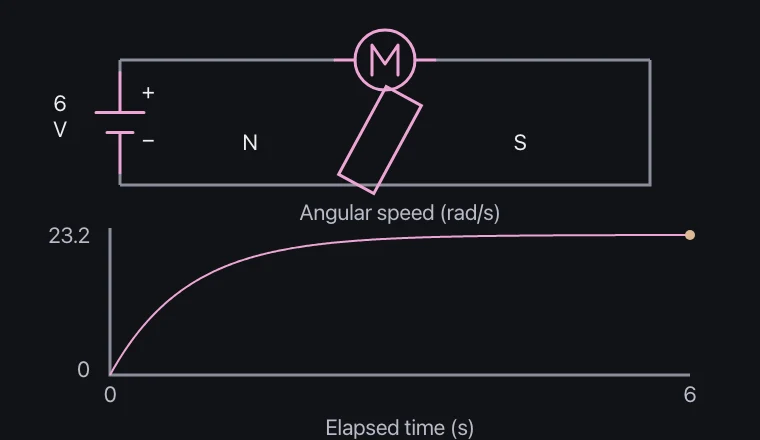
Meaning and mechanism
The force on current in a magnetic field produces torque on the two sides of the coil. A commutator reverses current in step with rotation to keep the torque acting in the same rotational direction.
A rotating coil generates an EMF, as in a generator, that opposes the supply voltage. This explains why the current differs just after starting from rest and during rapid rotation.
Relationships and conditions
In a simple model, where I=(V−kω)/R, the magnetic torque is proportional to kI. The rotational acceleration is determined by subtracting friction and load torque from this torque.
The approximation holds the magnetic field, motor constant, and viscous friction constant. Actual starting friction, commutation losses, and winding heating are separate effects.
What to observe in the simulation
The commutator maintains torque direction; back EMF reduces the current.
The field and coil are ideal and bearing friction is viscous. Without a commutator the simple model starts at π/4. Experiment on screen; do not reproduce this with real power supplies, outlets or high voltage.
Key relationships and symbols
Jω′ = kI−bω−τload · I = (V−kω)/R
| Symbol | Meaning | Unit |
|---|---|---|
| ω | Angular velocity | rad/s |
| kω | Back emf | V |
| J | Moment of inertia | kg·m² |
Worked example
With a 6 V supply, 0.968 A current and 5 Ω resistance, what is the back emf?
About 1.16 V
Common misconceptions
- It is not necessarily the case that the current consumed by a motor increases unconditionally as its speed increases.