
Meaning and mechanism
Schottky diodes exhibit different current characteristics depending on the direction. The value of a small signal resistance or threshold voltage is not a fixed, universal value.
If the effect of the junction barrier decreases in the reverse direction, the current increases significantly. The series resistance shares a portion of the power supply voltage, thereby limiting the abrupt increase in current.
Relationships and conditions
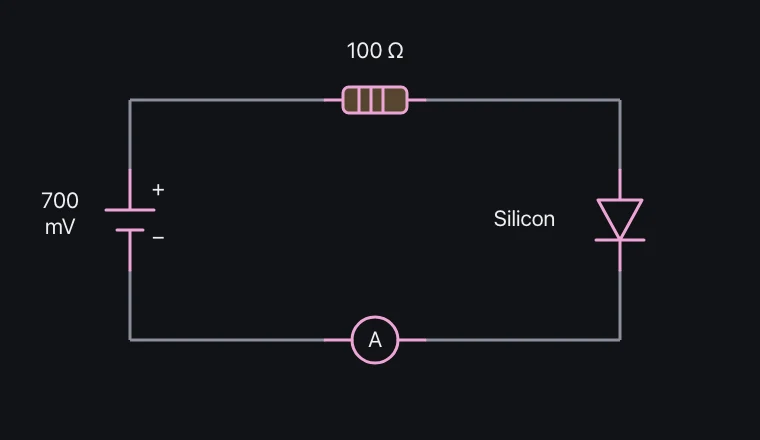
The Schöckler approximation is I=Is[exp(Vd/(nVT))−1]. In the circuit, it is necessary to find an operating point that satisfies Vin=IRs+Vd.
This translation aims to precisely convey the original Korean text, preserving all nuances and assumptions. This translation does not explain simple cooling as reverse yielding and self-heating. The method of temperature reflection in the experiment may differ from the overall temperature dependence of the actual device.
What to observe in the simulation
Forward current increases sharply and is limited by the series resistor. Threshold voltage depends on the chosen reference current.
The model uses the Shockley equation and a 100 Ω series resistor. Reverse breakdown, self-heating and LED efficiency are omitted. Temperature affects only VT, so real temperature dependence differs. Use this simulation; do not reproduce it with real power supplies or wall outlets.
Key relationships and symbols
I = Is(exp(Vd/(nVT)) − 1) · Vin = IRs + Vd
| Symbol | Meaning | Unit |
|---|---|---|
| Vd | Diode voltage | V |
| Is | Saturation-current coefficient | A |
| VT | Thermal voltage | V |
Worked example
What current flows with −5 V reverse bias on a silicon diode when breakdown is omitted?
Reverse current near zero
Common misconceptions
- Diodes do not all suddenly become perfect conductors at exactly 0.7 V.