
Meaning and mechanism
A cyclic heat engine returns to its initial internal state after one cycle. The difference between heat absorbed, Qin, and heat released, Qout, is the net work W.
The temperature difference between high and low storage areas creates conditions to obtain work using heat. In reality, actual irreversible processes reduce efficiency compared to the reversibility limit under the same temperature conditions.
Relationships and conditions
η=W/Qin is the value, and the Carnot efficiency is 1−Tc/Th. When using temperature ratios, it is essential to use the absolute temperature K, and the heat balance is Qin=W+Qout.
The maximum efficiency of the reversible mechanism operating between two storage tanks according to Carnot, is not a design based on detailed calculations of the actual mechanism’s combustion, friction, and heat transfer processes.
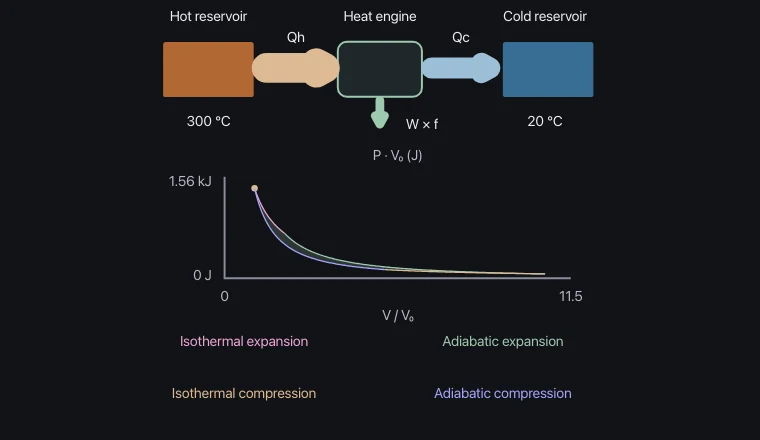
What to observe in the simulation
Carnot efficiency calculated in kelvin is the upper limit. Some input heat flows to the cold reservoir.
This simplified cyclic engine uses two reservoirs. Quality is a fraction of Carnot efficiency, not an engineering design rating. Combustion and friction are not resolved. Do not reproduce this with flames, hot or pressurized equipment.
Key relationships and symbols
ηCarnot = 1 − Tc/Th · W = Qin ηCarnot f · Qout = Qin − W
| Symbol | Meaning | Unit |
|---|---|---|
| Th, Tc | Hot and cold reservoir temperatures | K |
| W | Net work per cycle | J |
| η | Thermal efficiency | 0~1 |
Worked example
Which temperature unit belongs in the Carnot formula?
K · Carnot efficiency calculated in kelvin is the upper limit. Some input heat flows to the cold reservoir.
Common misconceptions
- Calculating Carnot efficiency using Celsius temperatures should not be done.