
Static friction varies as needed
Even if you gently push a box on the floor, as long as it remains stationary, the static friction force counteracts the applied force. If you apply a greater force, the static friction force also increases, eventually reaching its maximum value, μsN. Therefore, the magnitude of the static friction force is always greater than or equal to 0, but less than μsN.
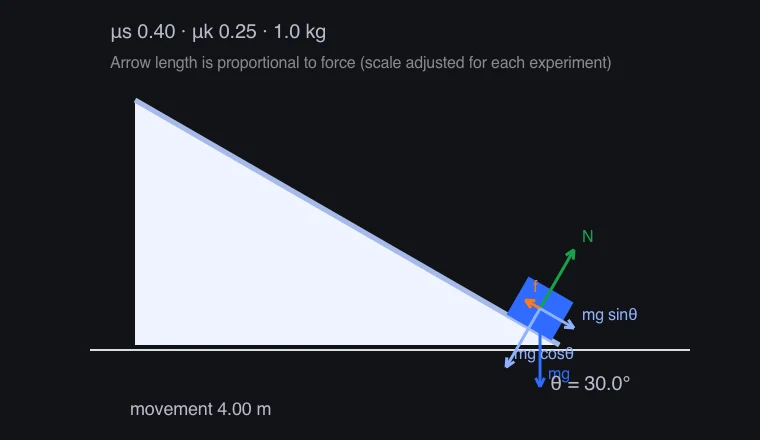
N represents the vertical force exerted by a contact surface pushing an object vertically. When there is no other vertical force on a horizontal surface, it is N = mg, but on an inclined surface, it is N = mgcosθ. If we assume that the vertical force is always equal to the weight, errors occur in problems involving inclined surfaces.
Condition for the start of sliding on an incline
The component of gravity pulling downwards at an angle θ is mgsinθ. The condition for static friction to resist this is mgsinθ ≤ μsmgcosθ. At the verge of slipping, tanθc = μs occurs. In a simple friction model, the mass is reduced, resulting in a critical angle that is independent of the mass.
For an object already sliding down the incline, kinetic friction acts upward with magnitude μkmgcosθ. The downward acceleration is g(sinθ − μkcosθ). This equation assumes downward sliding; reverse the friction direction for an object moving upward.
What does the coefficient of friction represent?
The coefficient of friction is a dimensionless number that represents the interaction between two surfaces. In many combinations, the coefficient of kinetic friction is smaller than the coefficient of static friction, demonstrating that a moving object tends to slide more easily than it remains stationary.
Actual friction can vary depending on surface deformation, temperature, contamination, and speed. This experiment is an approximation, keeping the friction coefficient constant while omitting the effect of contact area and air resistance. Friction is not the overall resistance to an object’s motion, but rather the force preventing relative sliding between the contacting surfaces.
Key relationships and symbols
0 ≤ fs ≤ μsN · fk = μkN · tanθc = μs · a = g(sinθ − μkcosθ)
| Symbol | Meaning | Unit |
|---|---|---|
| μs, μk | Static and kinetic friction coefficients | Dimensionless |
| N | Normal force | N |
| θc | Incline angle just before sliding begins | ° or rad |
| a | Acceleration down the incline | m/s² |
Worked example
If the static friction coefficient is 0.40, what is the critical angle?
The angle is θc = arctan(0.40) ≈ 21.8°. If this angle is increased by a small amount, it is no longer possible to maintain a stationary state. With a coefficient of kinetic friction of 0.25 and an angle of inclination of 30°, the value is a ≈ 9.8(0.5 − 0.25 × 0.866) ≈ 2.78 m/s².
Common misconceptions
- The object can remain stationary even if its static friction force does not reach its maximum value.
- The fact that there is friction does not always mean that an object’s velocity decreases. It is necessary to consider the interaction with other forces.