
Meaning and mechanism
Independent assortment occurs when allele segregation at one locus is independent of segregation at another. In the simple model, a YyRr individual produces four gamete combinations.
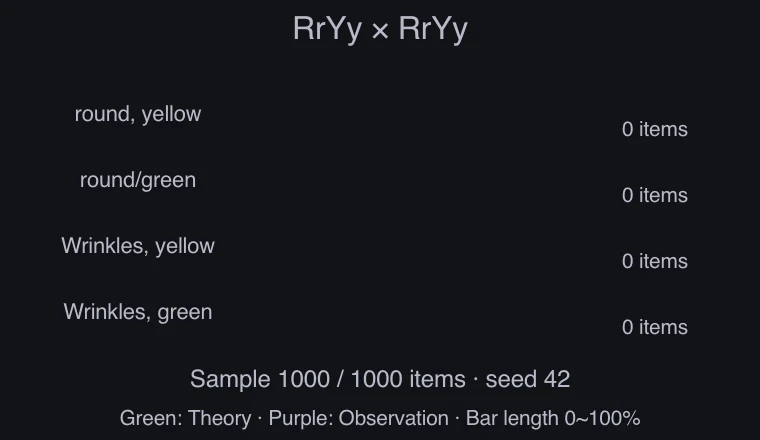
If the two loci assort independently, YR, Yr, yR, and yr gametes each occur with probability ¼. Combining the 3:1 phenotype probabilities for each trait gives four phenotype groups.
Relationships and conditions
When you multiply two allele probabilities, each with a value of 3/4 and 1/4, the result is 9/16, 3/16, 3/16, 1/16. This occurs when both parents are heterozygous and exhibit complete dominance at each locus.
Genes located close to each other on the same chromosome can be linked, and they can also influence each other’s phenotypes. Not all crosses between two genotypes are 9:3:3:1.
What to observe in the simulation
Two genes on different chromosomes separate independently. In a test cross, the four phenotypes appear with a 1:1:1:1 probability.
The assumption is that the two genes are on different chromosomes. Each gene is completely dominant and has the same probability of surviving gametes and offspring. Genetic linkage, epistasis, environment, selection, and cleavage errors are omitted. Sampling distributions may deviate from theoretical values. Dominance does not mean common or excellent.
Key relationships and symbols
(3:1) × (3:1) = 9:3:3:1
| Symbol | Meaning | Unit |
|---|---|---|
| YR, Yr, yR, yr | Gamete combinations at two loci | Classification |
| P(A∩B) | P(A)P(B) for independent events | Probability |
Worked example
What is the expected ratio of the four phenotypes in RrYy × rryy?
RrYy makes 1/4 of RY, Ry, rY, and ry, and rryy only makes ry. Assume the two genes are on different chromosomes.
Common misconceptions
- Simply observing two phenotypes does not automatically establish the condition of independent assortment.