
Meaning and mechanism
In the simple model, gametes from a heterozygous Yy individual receive Y or y with equal probability. Gametes from the two parents combine to determine an offspring’s genotype.
The combination of Yy × Yy results in YY, Yy, yY, and yy. If Y is completely dominant, the intermediate combinations are classified as exhibiting the same dominant phenotype as YY and yY.
Relationships and conditions
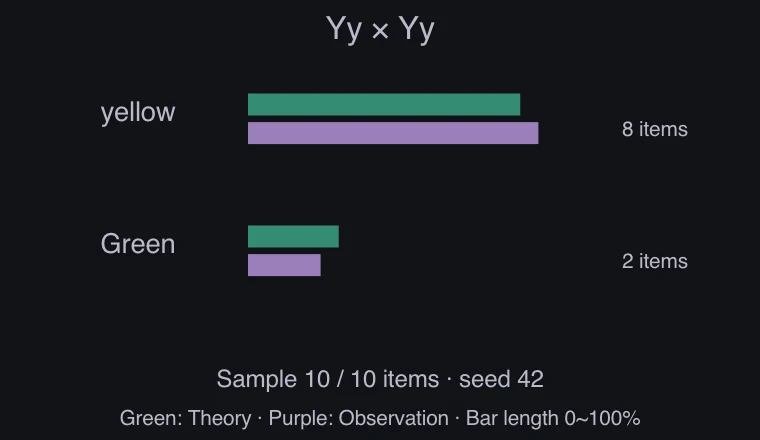
The expected ratio of genotypes is 1:2:1, and the expected ratio of phenotypes is 3:1. As the number of offspring increases, the observed ratio tends to approach the theoretical ratio, but it does not always match exactly.
There is one gene, exhibiting complete dominance, and assumptions such as equal survival probabilities. We do not apply 3:1 directly to traits that are influenced by incomplete dominance or multiple genes.
What to observe in the simulation
Theory ratio is probability. Small samples can deviate significantly, and even large samples are not guaranteed to be exactly 75%. Dominance does not mean that it is common or excellent.
Assume that the color-determining gene Y/y is completely dominant and that the offspring are independent with the same probability of fertilization and survival. It does not explain all the characteristics of actual peas. Association, environment, penetrance, and natural selection are omitted. If the random number seeds are the same, the results with the same number of parents and samples are reproduced.
Key relationships and symbols
Yy × Yy → YY:Yy:yy = 1:2:1 → Yellow:Green = 3:1
| Symbol | Meaning | Unit |
|---|---|---|
| Y, y | Alleles at one locus | Symbol |
| YY, Yy, yy | Possible genotypes | Classification |
Worked example
What is the theoretical genotype ratio and phenotype ratio of Yy×Yy?
Four different combinations YY, Yy, Yy, yy have the same probability. Yy is also yellow, so the phenotype is 3:1. Dominance does not mean that it is common or excellent.
Common misconceptions
- The term “dominant trait” does not mean that it is more common or superior to other traits.