
Meaning and mechanism
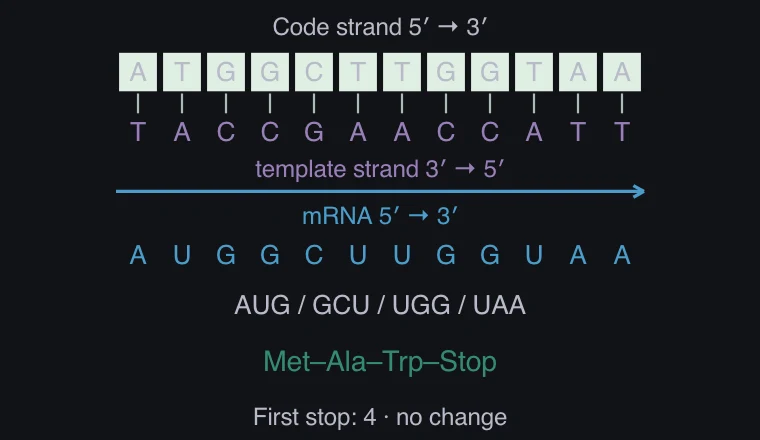
Transcription is the process of synthesizing complementary RNA on a DNA template. Translation is the process of reading codons—the three-base units of mRNA—and linking amino acids.
The DNA template and RNA align antiparallel. RNA uses uracil instead of thymine, and codons are read along mRNA in the 5′ to 3′ direction.
Relationships and conditions
Codon, consisting of three bases, can undergo substitution, resulting in the same amino acid, a different amino acid, or a stop signal. Insertions and deletions, which are not multiples of 3, can alter the reading frame.
The experiment utilizes a short hierarchy and a given reading frame. It does not predict RNA processing, gene expression regulation, or protein folding within eukaryotic cells.
What to observe in the simulation
ATG GCT TGG TAA is Met-Ala-Trp-termination. Substitutions can create silent mutations, missense, or nonsense, and single-base insertions/deletions can create frameshift.
It is a reading frame that uses 64 standard genetic codes and fixes the first base of the code strand. Start codon search, intron removal, regulation, and protein folding are omitted. ATG start loss is also translated into a fixed frame. Mutation determination is compared to a reference sequence, and changes after termination are seen as silent mutations in this short protein. Translation stops at the first termination and the remaining incomplete codons are not translated. It does not predict actual function or disease.
Key relationships and symbols
DNA template → mRNA (5′→3′) → codon → amino acid
| Symbol | Meaning | Unit |
|---|---|---|
| 5′, 3′ | Direction of the nucleic acid strand | Direction indicator |
| Codon | Three-base unit read during translation | Three bases |
Worked example
What mutation occurs if one base is inserted after the first codon?
Codons are read three bases at a time from a designated starting point. Insertions and deletions that are not multiples of 3 change the reading frame. Translation stops before the stop codon.
Common misconceptions
- It is not always the case that a change in a single base results in a change in amino acid or phenotype.