
Meaning and mechanism
The water that evaporates within the leaves primarily moves outwards through stomata. Transpiration is linked to the movement of water and inorganic substances, as well as the cooling of the leaves.
When the air is dry, the difference in water vapor between the inside and outside of the leaves increases, and wind can reduce the boundary layer. Closing stomata reduces water loss, but also changes CO₂ intake.
Relationships and conditions
In the experiment, we calculate relative speed by multiplying leaf area, stomatal opening, 1-relative humidity, and wind speed coefficient. We compare trends by changing one condition at a time for the same leaf.
A simple multiplication formula is not a universal physiological law of actual plants. Factors such as stomatal responses due to water deficiency and leaf temperature must be considered separately.
What to observe in the simulation
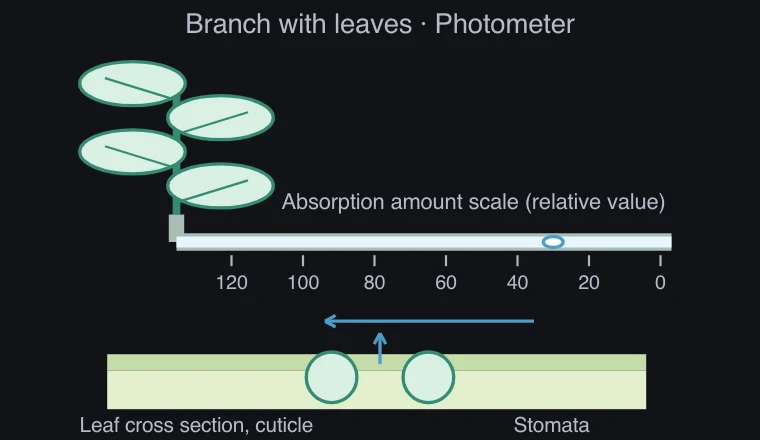
When humidity is high, transpiration decreases, and when wind and leaf area increase, it increases. Even when the stomata are closed, about 5% of the transpiration of the cuticle remains.
All moisture loss amounts and rates are virtual relative values. The wind coefficient of .2 s/m and the cutoff layer of 5% are assumed for illustrative purposes only. It is approximate that the water absorption of the photometer is equal to the amount of transpiration. Stomatal reactions due to moisture storage, light intensity, temperature, differences between species, and lack of moisture are omitted. The bubbles in the scale tube do not reset the accumulated value and anything outside the relative value of 120 is marked as out of scale.
Key relationships and symbols
v = leaf area × (.05+.95×stomata opening) × (1−relative humidity) × (1+.2×wind speed)
| Symbol | Meaning | Unit |
|---|---|---|
| relative humidity | Ratio to the saturated water vapor amount at the same temperature | % |
| Stomatal opening | Relative opening set in the simulation | 0~1 |
Worked example
What happens to water loss when the stomata are fully closed?
Effective opening = .05 + .95 × stomatal opening. At stomatal opening 0, .05 remains. The humidity effect is (1−.8)/(1−.5)=.4.
Common misconceptions
- If the wind is strong, it does not cause an increase in transpiration at the same rate in all plants and under all conditions.