
Meaning and mechanism
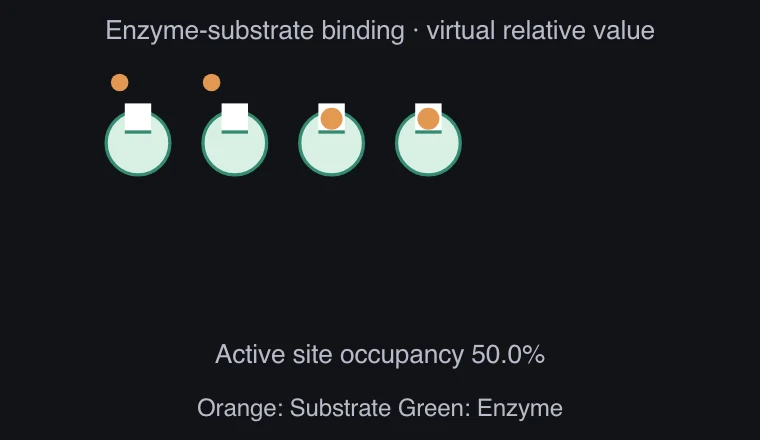
Enzyme is a biological catalyst that lowers the activation barrier for a reaction. When the amount of enzyme is constant, there is a limit to the amount of substrate that can be processed simultaneously.
At low substrate concentrations, increasing the substrate concentration results in a significantly increased reaction rate. However, further increases in substrate concentration have a smaller effect in regions where the enzyme’s binding sites are largely occupied.
Relationships and conditions
The Michaelis–Menten model is v=Vmax[S]/(Km+[S]). Competitive inhibition increases the apparent Km while leaving the Vmax approached at sufficiently high substrate concentration unchanged.
This equation applies under conditions such as initial-rate measurement and a steady-state approximation. Not every enzyme follows this curve, and not every inhibitor acts competitively.
What to observe in the simulation
The amount of enzyme is proportional to Vmax. Competitive inhibition increases the apparent Km while maintaining the Vmax for the same amount of enzyme.
This Michaelis–Menten initial-rate model uses simulated relative values, with Vmax=10×relative enzyme amount; actual enzyme parameters have not been established. Substrate depletion, reverse reactions, rate decrease over time, temperature, denaturation, and noncompetitive inhibition are omitted. The 4 s interval visualizes binding and is not the time used to measure product accumulation rate.
Key relationships and symbols
v = Vmax[S] / (Km(1+[I]/Ki)+[S])
| Symbol | Meaning | Unit |
|---|---|---|
| [S] | Substrate concentration | Concentration |
| Km | Substrate concentration at a rate of Vmax/2 | Concentration |
| Vmax | Maximum reaction rate for the given amount of enzyme | concentration/time |
Worked example
With no inhibitor and [S] = Km, what is the initial reaction rate?
If you put [S]=Km in v=Vmax[S]/(Km+[S]), v=Vmax/2. Competitive inhibition where [I]=Ki doubles the apparent Km and does not change Vmax.
Common misconceptions
- Even when continuously adding substrate after reaching saturation, the rate does not become infinitely large for the same enzyme.