
Meaning and mechanism
In anaerobic respiration, organic matter is broken down while electrons are transferred, and oxygen is used as the final electron acceptor. Plants also undergo respiration in living cells.
Since the amount of sample is large, the overall oxygen consumption can increase, so we will compare the consumption rate per unit mass. While an increase in temperature can accelerate enzyme reactions, this is not necessarily a universal increase.
Relationships and conditions
Q10 is the ratio of rates for a 10 °C temperature increase. The simulation uses Q10=2 to relate temperature to the initial consumption rate, but this is an assumed empirical model.
Damage at high temperatures, oxygen depletion, and differences in metabolism by type do not align with simple index models. Simply measuring oxygen consumption does not calculate the overall metabolism of all living organisms in the same way.
What to observe in the simulation
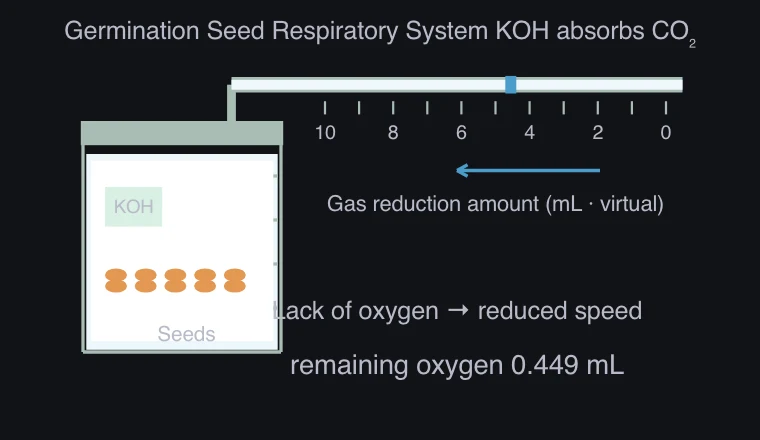
If there is enough oxygen, the speed doubles with a 10 °C rise, and the total speed is proportional to mass. When oxygen becomes scarce, the rate of consumption decreases and it becomes non-negative. Boiled seeds are 0.
It is a virtual model that assumes constant temperature, sealing, no leakage, and complete absorption of CO₂ by KOH. k=0.02 mL/(g·s), Q10=2 is used, and below the oxygen amount of 1 mL, the speed decreases in proportion to the oxygen amount. Assume that all initial oxygen is available. The scale moving distance is an explanatory scale and does not cover changes in gas temperature and pressure, actual practice of KOH hazards, and differences/denaturation by species.
Key relationships and symbols
v₀ = k·mass·2^((T−20)/10) · Q10=2
| Symbol | Meaning | Unit |
|---|---|---|
| Q10 | Rate ratio for a 10 °C temperature change | Dimensionless |
| v₀ | Initial oxygen consumption rate | oxygen amount/time |
Worked example
Why does the gas volume decrease even though the respiring seeds produce CO₂?
Assume that KOH absorbs CO₂ in a closed respiratory system. The remaining gas loss represents oxygen consumption. Boiled seeds are the control group with a respiration rate of 0.
Common misconceptions
- The statement that plants only perform photosynthesis and do not carry out cellular respiration is incorrect.