
Meaning and mechanism
Ionic solids are arrangements formed by electrostatic interactions between cations and anions. The chemical formula indicates the ratio of ions needed so that the solid as a whole is neutral.
Mg²⁺ ions each correspond to two Cl⁻ ions, resulting in MgCl₂. Al³⁺ and O²⁻ combine in multiples of the lowest common multiple 6, resulting in 2:3.
Relationships and conditions
The product of the positive charge and the number of positive ions must be equal to the product of the negative charge and the number of negative ions. After obtaining the result, divide by the greatest common factor to express it as the smallest integer.
It is not possible to guarantee the actual existence of matter or the formation of crystal structures solely based on charge and neutrality. With multi-atomic ions, it is possible to control the ratio of atoms within the ion while adjusting the number of clusters.
What to observe in the simulation
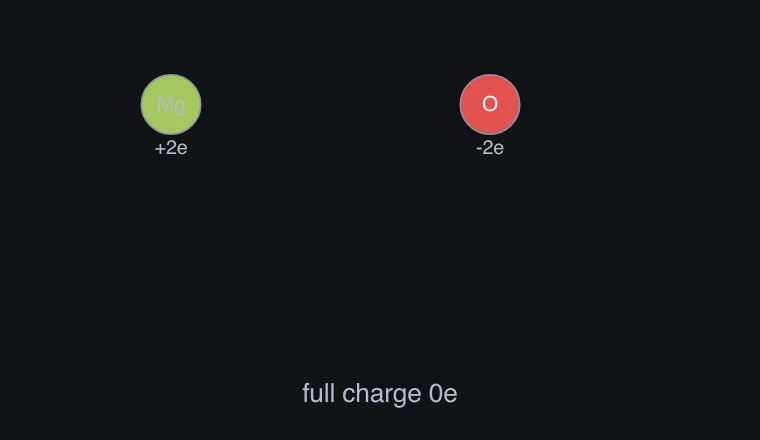
If you divide the number ratio where the charge becomes 0 by the greatest common divisor, you get the minimum integer ratio chemical formula.
It is a charge coefficient model that only deals with Na⁺·Mg²⁺·Al³⁺ and Cl⁻·O²⁻. The pictures represent numbers, not actual crystal lattices or individual molecular shapes. Binding energy and crystal stability are not calculated.
Key relationships and symbols
Positive charge × number − negative charge size × number = 0
| Symbol | Meaning | Unit |
|---|---|---|
| z₊, z₋ | Magnitudes of cation and anion charges | Dimensionless |
| n₊, n₋ | Number of ions per formula unit | items |
Worked example
If the charges of 2 Mg²⁺ and 2 O²⁻ are 0, what is the chemical formula?
Chemical formulas use the minimum whole number ratio. If you reduce 2:2 to 1:1, you get MgO.
Common misconceptions
- MgCl₂: the subscript below 2 does not mean that the chloride ion has a charge of −2, but rather that there are two chloride ions.