
Meaning and mechanism
The atom’s electron pair repulsion model predicts an arrangement where electron density around the central atom tends to move away from each other. It must consider both bonding regions and non-bonding electron pairs.
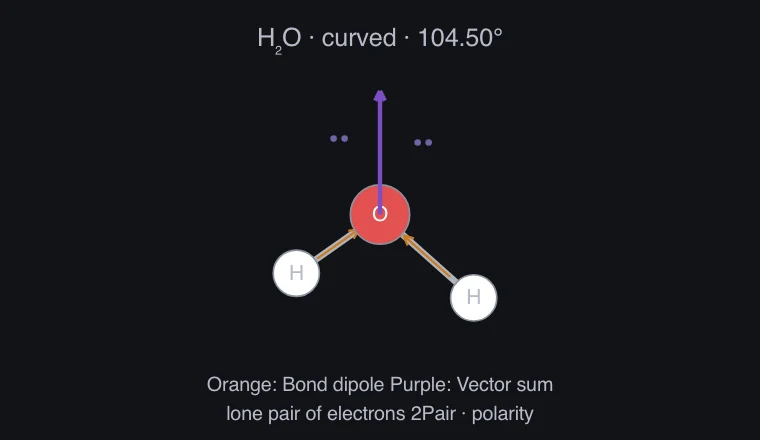
Water molecules are curved in shape due to their non-shared electron pairs, and they exhibit a persistent bond dipole that is not cancelled out. Carbon dioxide is symmetrical in a linear form, resulting in the cancellation of the effects of the two bonds.
Relationships and conditions
Dipole moments of molecules are the vector sum of each bond dipole. It is not simply about adding the magnitudes, but rather considering both the direction and the bond angle is necessary to accurately determine the overall polarity.
This model is an approximation for describing the shape of a representative molecule. Actual bond angles and electron density vary depending on the type of atom and the nature of the bond.
What to observe in the simulation
H₂O·NH₃ is polar, and CO₂·CH₄ is nonpolar. Even if there is a polar bond, if it is symmetrical, the sum can be 0.
It is a fixed ideal structure of H₂O 104.5°, CO₂ 180°, NH₃ 107°, and CH₄ approximately 109.47°. The size of each bond dipole in the same molecule is set to 1 relative unit. It is not a size comparison between molecules or Debye actual measurements. It does not calculate new stable structures, electron densities, or vibrations. The arrow points toward the negative charge. The bond angle is a three-dimensional angle, not the projected screen angle.
Key relationships and symbols
Molecular dipole = vector sum of bond dipoles
| Symbol | Meaning | Unit |
|---|---|---|
| μ | Electric dipole moment | C·m or D |
| θ | Angle between bonds | ° |
Worked example
Why is H₂O polar and CO₂ nonpolar?
Molecular polarity is determined by the vector sum of three-dimensional bond dipoles. Even if you turn the viewpoint, the polarity of the molecule itself is the same.
Common misconceptions
- The mere fact that a molecule exhibits polar bonding does not necessarily mean that the entire molecule is polar.