
Meaning and mechanism
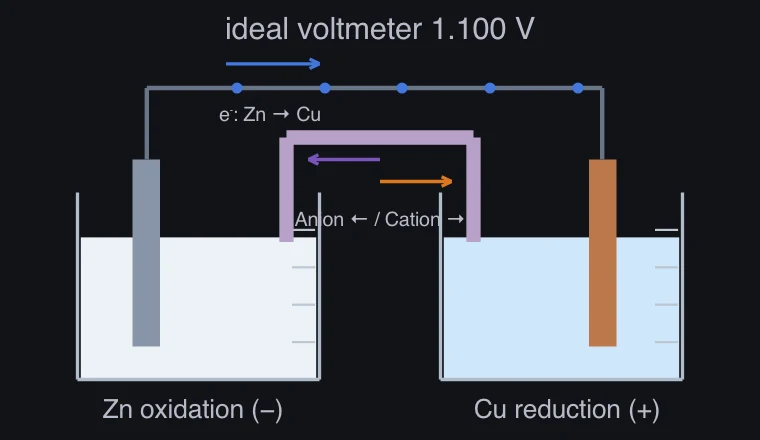
At the zinc electrode, Zn becomes Zn²⁺, releasing electrons, and at the copper electrode, Cu²⁺ accepts electrons and becomes copper. This is a process where oxidation and reduction are linked together.
Electrons flow through the external circuit from zinc to copper. The salt bridge provides an ionic path that reduces charge imbalance in the solutions; it does not carry electrons directly like a metal wire.
Relationships and conditions
In the simple concentration approximation of 25 °C, the ratio is E=1.10−(0.0592/2)log₁₀([Zn²⁺]/[Cu²⁺]). The reaction index and temperature affect the potential difference.
The activity level is approximated using conductivity, and the comparison is made with a potential closer to equilibrium. When the actual current is high, variations in internal resistance, polarization, and concentration cause differences in the terminal voltage.
What to observe in the simulation
Electron flow requires charge balancing through closed external circuits and salt bridges. In a salt bridge, ions, not electrons, move.
As long as 25 °C and E°=1.10 V, it is the Nernst model. Concentration is used instead of activity level. The voltmeter displays the calculated open-circuit voltage. When separating the salt bridge, the actual terminal voltage is not predicted. The current is a relative indicator of connection, E/1.10, not the actual current in A. Internal resistance, polarization, concentration consumption, liquid-to-liquid potential, and instantaneous transient current are excluded. When disconnected, the continuous current is immediately treated as 0.
Key relationships and symbols
E = 1.10 − (0.0592/2) log₁₀([Zn²⁺]/[Cu²⁺])
| Symbol | Meaning | Unit |
|---|---|---|
| E | Cell potential difference | V |
| [Zn²⁺], [Cu²⁺] | Approximation of ion concentrations in solution | mol/L |
Worked example
What is the movement of electrons and salt bridge ions in the external conductor?
Zn is oxidized and gives up electrons, and Cu²⁺ is reduced. A salt bridge maintains charge balance on both sides of the solution by moving ions.
Common misconceptions
- Without a salt bridge, charge imbalance can accumulate and hinder a sustained cell reaction.