
Meaning and mechanism
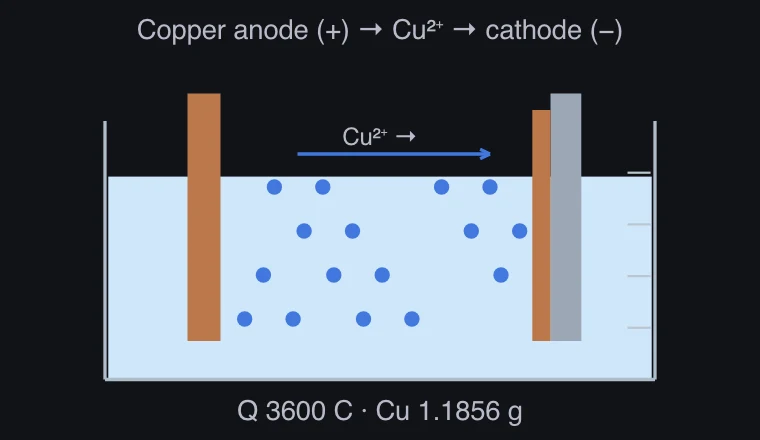
At the copper plating cathode, Cu²⁺ ions accept two electrons and become copper atoms. To achieve the desired deposition of metal on the object being plated, it must be connected to an appropriate electrode.
As the current increases, the amount of charge delivered per unit of time also increases. Even with the same current, the total amount of charge that can be used in a reaction increases over a longer period of time.
Relationships and conditions
The mass for Q=It is m=QM/(zF). Copper has a density of z=2. Assuming that it is uniformly stacked, the average thickness is calculated by dividing the mass by density and area.
The theoretical value is a current efficiency of 100% with no side reactions or losses. However, the actual surface thickness may not be uniform, depending on the current distribution, the shape of the object, and the solution state.
What to observe in the simulation
Mass is proportional to current and time and is independent of area. If the same mass is plated wider, the average thickness becomes thinner.
It is an educational model with 100% current efficiency, constant current, M=63.55 g/mol, n=2, F=96485 C/mol, ρ=8.96 g/cm³. The Cu²⁺ supplied by the copper anode is sufficient, excluding concentration depletion, side reactions, voltage, surface roughness, and thickness unevenness. The area is the total plating surface area, and only the uniform average thickness is calculated. The thickness of the plating layer picture is an enlarged representation.
Key relationships and symbols
Q = It · m = QM/(nF) · Average thickness = m/(ρ·area)
| Symbol | Meaning | Unit |
|---|---|---|
| Q | Total electric charge | C |
| F | Faraday constant, approximately 96485 | C/mol |
| z | Number of electrons required per metal ion | Dimensionless |
Worked example
What determines the copper precipitate mass at 100% current efficiency?
m=ItM/(nF) and the average thickness is m/(ρ·area). Area determines how widely the same mass is divided.
Common misconceptions
- If coated with the same total charge, the average thickness decreases when the area is wider.