
Meaning and mechanism
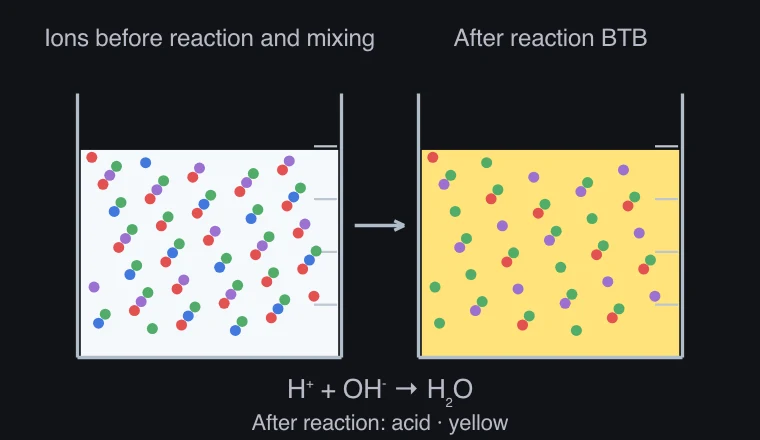
In simple aqueous strong-acid/strong-base solutions, H⁺ and OH⁻ react to form water. Spectator ions that do not participate directly in the reaction remain in solution.
Stoichiometric neutralization occurs when the amounts of hydrogen ions supplied by the acid and hydroxide ions supplied by the base match. Which ions remain and whether the solution is acidic or basic depend on which reactant is in excess.
Relationships and conditions
Calculate the amount of reacting ions in moles as concentration × volume, accounting for how many ions each acid or base formula unit supplies. A 10 mL sample of 0.1 mol/L HCl contains 1 mmol of H⁺.
An equivalence-point pH of 7 applies only under particular conditions, such as the usual strong-acid/strong-base case at 25 °C. Weak acids, weak bases, and salt hydrolysis can change the equivalence-point pH.
What to observe in the simulation
All of the ions on the smaller side react and the more ions remain. The number of moles of Na⁺·Cl⁻ before and after the reaction is the same.
It is a monovalent strong acid/strong base model in which HCl·NaOH completely dissociates. Precise pH, automatic ionization of water, and heat of reaction are not covered. BTB is an introductory classification of acid yellow, neutral green, and basic blue, and the actual discoloration section is omitted. The dots are a group picture, and the actual numbers are indicated as N=nNₐ in the table.
Key relationships and symbols
H⁺ + OH⁻ → H₂O · n = cV
| Symbol | Meaning | Unit |
|---|---|---|
| n | Amount of reacting ions | mol |
| c | Molar concentration | mol/L |
| V | Solution volume | L |
Worked example
What condition defines the neutralization equivalence point?
In monovalent strong acids and strong bases, when c acid (V acid) = c base (V base), H⁺ and OH⁻ are not left. Na⁺·Cl⁻ remains as a spectator ion.
Common misconceptions
- Mixing equal volumes of acid and base does not necessarily give equal amounts, in moles, of the reacting ions.