
Meaning and mechanism
In acid–base titration, add a standard solution gradually and use the reaction’s stoichiometry. The equivalence point is where both reactants have been consumed in the ratio specified by the balanced equation.
The observation point where the indicator color changes is the endpoint. When an appropriate indicator is used, the point of equivalence is approached, but these two terms are not the same by definition.
Relationships and conditions
For a monoprotic strong acid reacting 1:1 with a strong base, c_acidV_acid=c_baseV_equivalence. The titration curve locates the equivalence region from the change in pH as titrant volume increases.
Before or after the equivalence point, divide the excess amount of ions, in moles, by the total solution volume. Near equivalence, do not simply set H⁺ to 0; water’s equilibrium must also be considered.
What to observe in the simulation
At 25℃, Kw=10⁻¹⁴. The equivalence point pH is 7, and the concentration right next to the equivalence point is also calculated using the concentration of excess moles divided by the total volume and the auto-ionization of water. The estimated acid concentration is c base V terminal/V acid.
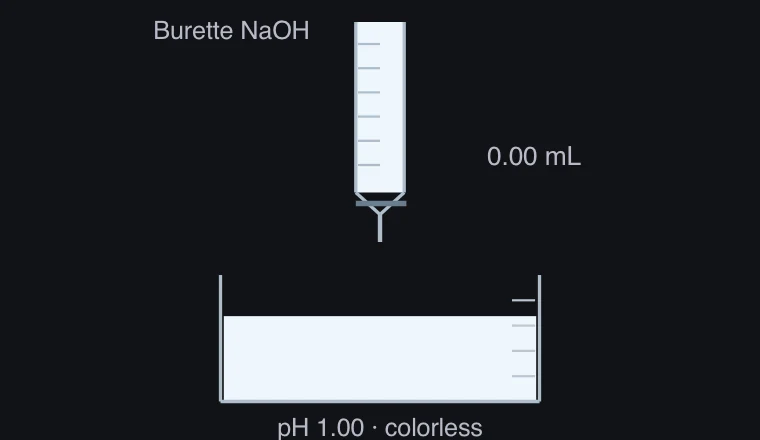
Assume 25℃ monovalent strong acid HCl·strong base NaOH, complete dissociation·volume addition·activity 1. Carbon dioxide absorption, mixing delay, and droplet size errors are excluded. The discoloration range is a representative value for educational purposes, and the end point is a model defined as the pH in the middle of the range (9.10 or 3.75). It may differ from the actual visual endpoint. Indicators do not change pH.
Key relationships and symbols
D=(n acid−n base)/V total · [H⁺]−Kw/[H⁺]=D
| Symbol | Meaning | Unit |
|---|---|---|
| V_equivalence | Titrant volume at the stoichiometric equivalence point | L |
| c_acid, c_base | Molar concentration of each solution | mol/L |
Worked example
Are the equivalence point and an indicator’s endpoint always identical?
The equivalence point is the point where n(H⁺)=n(OH⁻). The end point is a color change standard that is observed, so it varies for each indicator. The curve is the same even if you change the indicator.
Common misconceptions
- Adding the equivalence-point volume does not guarantee pH 7 for every acid–base combination.