
Meaning and mechanism
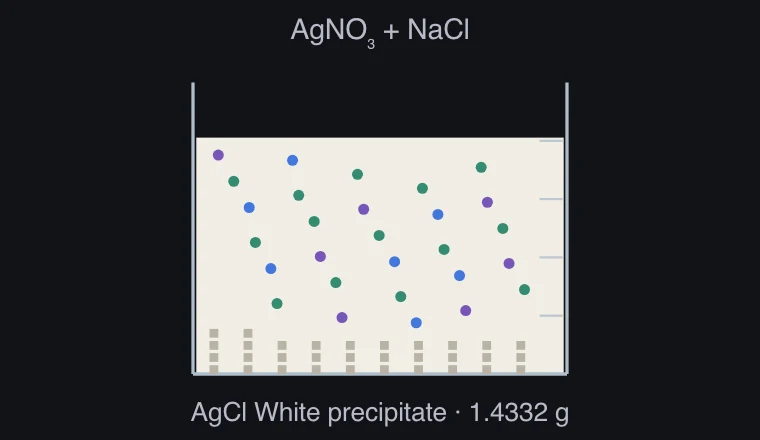
When ions in a solution meet, and form a solid with low solubility, precipitation occurs. It is not the case that all ions in the solution enter the solid.
Ag⁺ and Cl⁻ can form AgCl solid. Like Na⁺ and NO₃⁻, which remain in solution when added together, these ions are excluded from the overall ion reaction equation.
Relationships and conditions
In the approximate 1:1 range of Ag⁺+Cl⁻ → AgCl, the extent of precipitation removal is smaller than the smaller of the two ion molar amounts. The mass is calculated by multiplying the amount of precipitation by the molar mass.
The actual precipitation occurs when the ratio of the ion product and the solubility product is determined, and a small amount may remain in the solution. The experiment uses an approximation where a specific precipitation reaction proceeds quantitatively.
What to observe in the simulation
Only ions that meet in a given reaction table form solids. Multiply the number of moles of reagent by the number of ions in the chemical formula and find the limiting ion. There are 2 moles of Cl⁻ in 1 mol of BaCl₂.
We only use fixed reaction tables of four reagents. Ag⁺+Cl⁻ and Ba²⁺+SO₄²⁻ precipitate completely, and other combinations are treated as no precipitation. In particular, the actual dissolution equilibrium of Ag⁺+SO₄²⁻ is also excluded from this introductory model. Ksp, activity, particle growth, and temperature effects are not calculated. The molar mass is rounded to 143.32 AgCl, 233.39 g/mol BaSO₄. The dots and solid pieces are for illustrative purposes only.
Key relationships and symbols
n precipitation = min(n positive ion, n negative ion) m = n precipitation M
| Symbol | Meaning | Unit |
|---|---|---|
| n_precipitate | Amount of solid formed | mol |
| M | Molar mass of the precipitate | g/mol |
Worked example
Why are Na⁺ and NO₃⁻ called spectator ions?
AgCl(s) is made by mixing only Ag⁺ and Cl⁻ 1:1. Na⁺ and NO₃⁻ are omitted from the net ionic equation because they remain in aqueous solution.
Common misconceptions
- It’s not the case that even observer ions disappear from the solution entirely when precipitation occurs.