
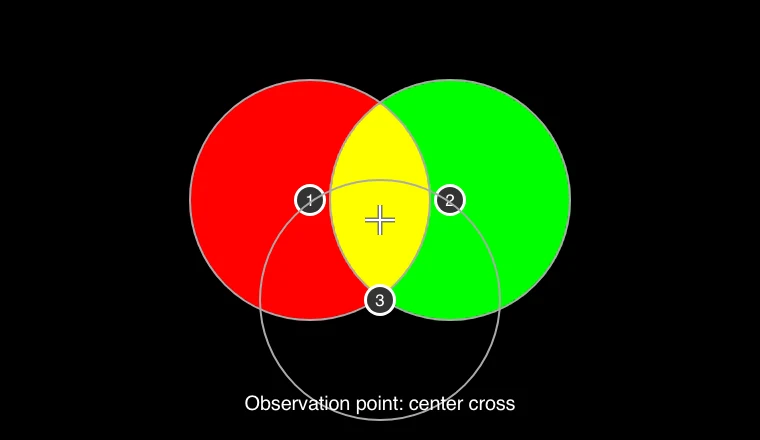
RGB adds the light reaching the observer
Additive mixing occurs when light from multiple sources arrives simultaneously at the eye or a detector. When the red and green components of an RGB model are combined appropriately, the result is yellow; when green and blue are combined, cyan is perceived; and when blue and red are combined, magenta is perceived. If all three components are combined in the right proportions, white is produced.
It does not necessarily mean that something appears yellow simply because it looks yellow. If different wavelengths cause similar reactions in the three types of cone cells in the human eye, they can appear as a similar color. RGB does not mean that all light is physically replicated exactly using three names for wavelengths.
In CMY, light is produced that cannot pass through.
An ideal color filter reduces red, magenta reduces green, and yellow reduces blue. When cyan and magenta filters are layered on white, red and green are eliminated, leaving blue. If all three filters completely block each color component, the result is black.
The act of adding light that appears to be the same color, and layering a color filter on top of it, are distinct processes. The effect of a filter depends on the specific components present in the incident light. A filter does not create components that were not originally present in the light.
Why do screen values differ from real paint?
The sRGB number for the screen does not simply correspond to the intensity of physical light. The experimental RGB mixing adds linearly increased light, and then converts it to a screen display value. Simply calculating the arithmetic average of the numbers can result in a different brightness outcome.
The CMY mode is a simple filtering method that multiplies the transmission rates of each channel. However, actual paints are far more complex, involving pigment scattering, particle scattering, and effects due to the paper and lighting. The result of the experiment—that three ideal filters result in black—should not be interpreted as an accurate prediction of all actual paints.
Key relationships and symbols
Additive: R + G → yellow · Subtractive: cyan + magenta filters → blue · T = (1−C, 1−M, 1−Y)
| Symbol | Meaning | Unit |
|---|---|---|
| R, G, B | Red, green, and blue light components | Relative intensity |
| C, M, Y | Strengths of cyan, magenta, and yellow filters | 0~1 |
| T | Ideal transmittance of each RGB channel | 0~1 |
Worked example
What is the difference between overlapping red and green light, and overlapping cyan and magenta filters?
In the first case, red and green components coexist, resulting in a yellow appearance. In the second case, red and green are removed from the white, leaving blue. One adds light, and the other removes it.
Common misconceptions
- Adding green and red light together does not result in a darker color like paint.
- CMY filter models do not accurately reproduce the actual mixing of all pigments.