
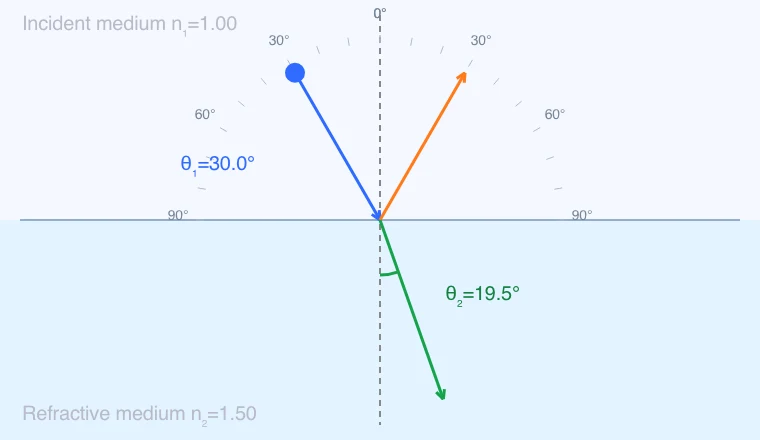
The angles are measured with respect to the normal, not the boundary.
The line of sight (or bisector) is a line that is perpendicular to the boundary plane at the point where light enters. The incidence angle θ₁ and the refraction angle θ₂ are the angles between the line of sight and the light. If you directly input these angles into the formula, you will obtain a different result.
When the refractive index n = c/v is large, the speed of light’s phase velocity is smaller. In ordinary transparent media, when transitioning from a low refractive index to a high refractive index, the light bends toward the normal, and conversely, away from the normal. When light is incident vertically, even if the speed changes, the direction of propagation does not change.
The calculation is performed for the degree at which it decreases according to the law of Snell.
At the boundary between two media, n₁sinθ₁ = n₂sinθ₂. First identify the incident medium, then calculate the sine of the refracted angle. Even at the same incidence angle, changing the ratio of refractive indices changes the refraction angle.
For propagation from n₁ > n₂, increasing incidence angle can make the calculated sinθ₂ exceed 1. This does not mean a physical refraction angle greater than 90°; it indicates total internal reflection, with no propagating refracted ray. Use the separate critical-angle condition to determine total internal reflection.
Frequency remains unchanged across the boundary
The frequency of light vibrations is maintained at the medium boundary, regardless of time. Because the speed of light changes, the wavelength changes according to v = fλ. If the vacuum wavelength is λ₀, the wavelength within the medium is λ₀/n. The wavelength becomes shorter in the medium with a larger refractive index.
An ideal light model represents light as a thin line and calculates the direction at the boundaries. Actual boundaries can result in reflection, and the refractive index can vary depending on the wavelength. Using a single light beam in the experiment does not explain the dispersion of all colors and the wave effect.
Key relationships and symbols
n = c/v · n₁sinθ₁ = n₂sinθ₂ · λ_medium = λ₀/n
| Symbol | Meaning | Unit |
|---|---|---|
| n₁, n₂ | Refractive indices of the incident and refracting media | Dimensionless |
| θ₁, θ₂ | Angles of incidence and refraction measured from the normal | ° or rad |
| c, v | Speed of light in vacuum and in the medium | m/s |
| λ | Wavelength | m |
Worked example
What happens when light from air with n₁ = 1 enters glass with n₂ = 1.5 at an incidence angle of 30°?
Because of sinθ₂ = (1/1.5)sin30° = 1/3, the angle is θ₂ ≈ 19.5°. When moving from glass to air, it is necessary to first check the possibility of total internal reflection.
Common misconceptions
- The angle of refraction is measured relative to the refractive index, not the interface.
- Even if the speed and wavelength change due to refraction, the fundamental frequency of vibration remains constant within a static boundary.
Explore this concept through experiments
Compare the cases where the order of the refractive index is reversed, but the incident angle is the same, and the refractive index bends either towards or away from the normal.
Convex lenses and imagesObserve the process by which the direction of light passing through the lens creates a pattern/shape (or “a formation”).