
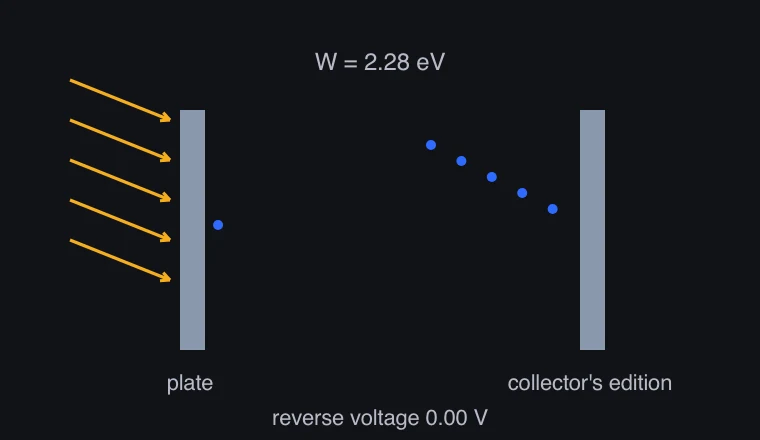
Minimum energy required to release an electron
The energy of a photon with a vibration number f is E = hf. The minimum energy required to extract an electron from a metal is referred to as the work function W. According to the law of conservation of energy, the maximum kinetic energy of the emitted electron is Kmax = hf − W.
The threshold frequency is f₀ = W/h. For f < f₀, increasing intensity does not produce photoelectron emission in this single-photon model. Exactly at threshold, the ideal maximum kinetic energy is 0; above it, the kinetic energy can be positive. The actual work function can also vary with the condition of the metal surface.
The frequency and amplitude exchange different values.
Increasing the frequency of vibration within the same metal results in an increase in the energy of a single photon, which leads to an increase in its maximum kinetic energy. Increasing the intensity at the same frequency results in an increase in the number of photons reaching a unit of time, which can lead to an increase in the number of electrons that can be emitted and the saturation current.
Brighter light does not increase each photoelectron’s maximum kinetic energy. Conversely, even above threshold frequency, intensity 0 means no arriving photons and no electron emission. Distinguish a photon’s energy from the amount of photon flow.
We read the maximum kinetic energy by using the resistance voltage.
Apply a reverse voltage that opposes emitted electrons. The magnitude at which even the most energetic electrons are no longer collected is the stopping potential Vs, with eVs = Kmax. Using electronvolts, a maximum kinetic energy of 1.2 eV corresponds to a stopping-potential magnitude of 1.2 V.
Real photoelectrons have an energy distribution, and the current depends on reverse voltage. The simulation simplifies this by assigning Kmax to every emitted electron, so current becomes 0 at the stopping boundary. Distinguish this simplified current model from Einstein’s energy relationship.
Key relationships and symbols
E_photon = hf · Kmax = hf − W · f₀ = W/h · eVs = Kmax
| Symbol | Meaning | Unit |
|---|---|---|
| h | Planck's constant, approximately 6.626 × 10⁻³⁴. | J·s |
| W | Work function of the metal | J or eV |
| Kmax | Maximum kinetic energy of photoelectrons | J or eV |
| Vs | Magnitude of the stopping potential | V |
Worked example
If the photon energy is 3.0 eV, and the work function is 2.0 eV, then?
Kmax = 3.0 − 2.0 = 1.0 eV, and the stopping potential has magnitude 1.0 V. Doubling intensity at the same frequency leaves the maximum kinetic energy at 1.0 eV. A 1.5 eV photon, below the work function, cannot cause emission in this model.
Common misconceptions
- The fact that a single photon can produce a photoelectric effect does not simply mean that it illuminates light at the threshold.
- Maximum kinetic energy does not mean that every real photoelectron has that kinetic energy.