
Meaning and mechanism
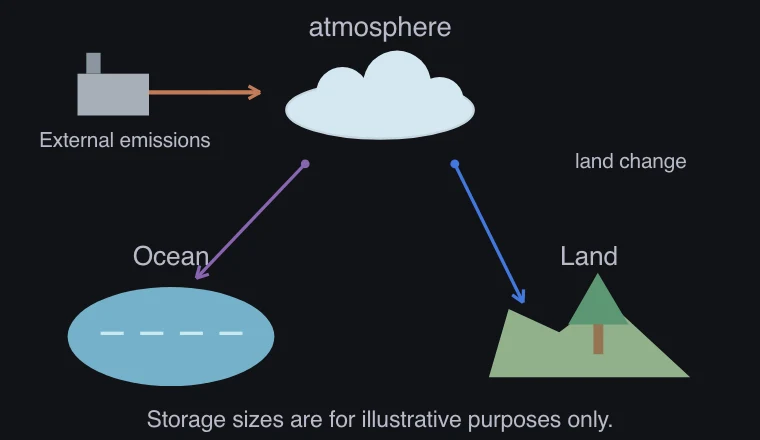
The atmosphere, oceans, and land all store carbon and exchange it with each other. A decrease in one storage area can lead to an increase in another.
If absorption increases in the ocean or on land, it can help reduce the increase in atmospheric carbon dioxide; however, it does not mean that all carbon will disappear. Changes in land can also create movement between storage sites.
Relationships and conditions
The change in the total volume of the three storage units corresponds to the accumulated carbon added from the outside. Internal exchanges must be offset within the sum of the three units.
The original source of the fossil carbon is outside the boundaries of this model. Actual absorption and re-release are influenced by the complex effects of climate, ecosystems, and marine chemistry.
What to observe in the simulation
Absorption moves carbon to the ocean and land. Land change moves from land to atmosphere but does not increase the sum of the three reservoirs.
It is a virtual three-box model starting with GtC of 850 in the air, 38,000 in the ocean, and 2200 on land. A linear absorption/reverse exchange coefficient is applied to the carbon difference compared to the initial value, and land change is calculated as internal movement. 2.12 GtC/ppm is a fixed conversion value. The original reservoir of fossil carbon is outside the model. It does not calculate the complex feedbacks/temperature of the actual carbon cycle and is not a climate prediction.
Key relationships and symbols
Δ(A+O+L)=Cumulative external emissions/atmospheric ppm=A/(2.12 GtC/ppm)
| Symbol | Meaning | Unit |
|---|---|---|
| A, O, L | Carbon stored in the atmosphere, ocean, and land | GtC |
| ppm | Atmospheric mixing-ratio representation | Parts per million |
Worked example
If carbon moves from land to the atmosphere due to land change, what is the total amount?
Land → air is internal movement. The sum of the three boxes increases by the external emissions. A 2.12 GtC increase in atmospheric carbon converts to an increase of 1 ppm.
Common misconceptions
- The carbon in the overall model did not decrease by the same amount as the decrease in atmospheric carbon.