
Meaning and mechanism
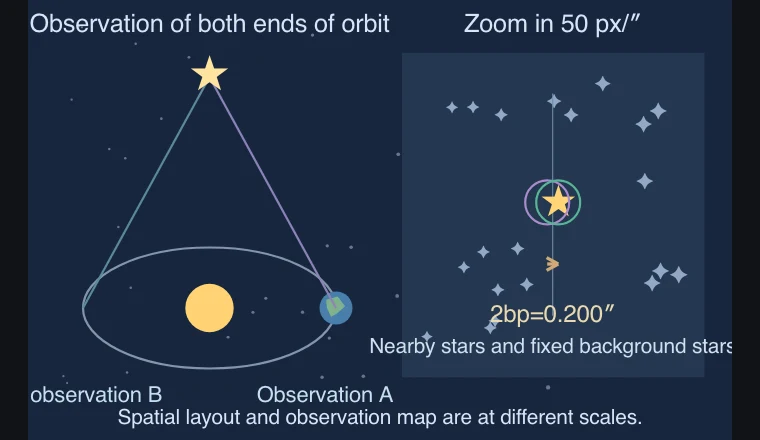
Time difference is the phenomenon where the apparent direction of an object changes when the observation point is changed. The difference in direction is greater when the object is closer.
When observed from the opposite side of Earth’s orbit, the reference point is approximately 2 AU. Since the standard time offset, ‘p’, is defined relative to 1 AU, it is distinguished from the overall displacement 2p.
Relationships and conditions
In the small-angle approximation, d(pc)=1/p, with p measured in arcseconds. If p=0.1 arcseconds, the distance is 10 pc. Changing the baseline changes both the observed angular displacement and its conversion to distance.
It is necessary to consider observation errors, the proper motion of stars, and the shape of the differential ellipse depending on the position of celestial bodies. The magnified angles of the experiment are not read as the actual size of the sky.
What to observe in the simulation
If p=0.1″, then 10 pc≈32.6 light years. The more distant a star is, the smaller the parallax is.
It is a small angle approximation assuming a circular orbit and a star oriented perpendicular to the orbital plane. p is always the standard parallax angle for 1 AU. At radius b AU, total displacement = 2bp, distance = b/(displacement/2). Background stars are fixed and intrinsic motion, atmospheric shaking, and measurement errors are omitted. The screen angle is an enlarged picture, not the actual angle.
Key relationships and symbols
d(pc)=1/p(″) · Standard total angular displacement=2p
| Symbol | Meaning | Unit |
|---|---|---|
| p | Annual parallax for a 1 AU baseline | Arcseconds |
| d | Distance to the star | pc |
| AU | Reference mean Earth–Sun distance | Unit of length |
Worked example
What is the relationship between the standard parallax p and the total angular displacement between the two observation points?
p is a semi-angle corresponding to the orbital radius of 1 AU. The total angular displacement at both ends is 2p and d(pc)=1/p(″).
Common misconceptions
- If you directly input the entire coordinate change over 6 months into the standard p, you may obtain an incorrect distance.