
Meaning and mechanism
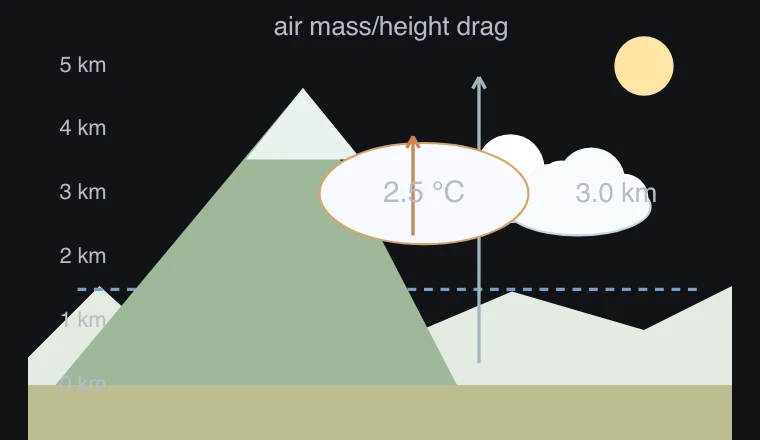
As the air mass rises, it expands due to a decrease in surrounding pressure. In cases where heat exchange with the outside is a small approximation of insulation, the temperature decreases as it expands.
When the air temperature approaches the dew point, the relative humidity increases. This difference in temperature decrease rate compared to when the air is dry is due to the release of latent heat following saturation.
Relationships and conditions
Before saturation, the simulation assumes that air temperature falls by 10 °C/km and dew point by 2 °C/km. It approximates the condensation height as (T−Td)/8 km because the difference between the two decreases at that rate.
The wettability and thermal resistance of a surface actually change depending on temperature, pressure, and humidity levels. This simple model does not predict the height or rainfall of all clouds.
What to observe in the simulation
Before condensation, the model reduces air temperature by 10 °C per km and dew point by 2 °C per km. After condensation, it uses an air-temperature decrease of 5 °C per km.
It is an interval approximation that sets the dry, dew point, and wet lapse rates as constants of 10, 2, and 5 ℃/km, respectively. The lapse rate changes due to mixing, radiation, and atmospheric pressure are omitted. Stability/unstability is a buoyancy judgment that compares the surroundings and temperature at a given height, and is not the stability of the entire atmosphere or the actual cloud and precipitation forecast.
Key relationships and symbols
Condensation altitude = (T−Td)/8 km
| Symbol | Meaning | Unit |
|---|---|---|
| T, Td | Initial air temperature and dew point | °C |
| Lapse rate | Rate of temperature change with height | °C/km |
Worked example
What is the temperature of the air parcel at the condensation altitude of 1.5 km?
(25−13)/(10−2)=1.5 km. Before condensation, it cools by 10 ℃/km, so 25−10×1.5=10 ℃.
Common misconceptions
- It is not possible to explain the phenomenon of air rising and cooling solely by describing it as a process where higher locations “steal” heat by cooling the air.