
Meaning and mechanism
The luminosity of a star is the total rate of energy emitted from its entire surface. When a star is far away, the amount of energy received per unit area decreases, making it appear darker.
In the black-body approximation, the emissivity of a surface is proportional to the square of the temperature, and the surface area is proportional to the square of the radius. Hotter or larger stars can exhibit a larger luminosity.
Relationships and conditions
L∝R²T⁴, and the observed flux is F=L/(4πd²). Doubling temperature at a fixed radius increases luminosity by a factor of 16. Doubling distance at fixed luminosity reduces apparent brightness to ¼.
Real stellar spectra contain absorption lines, and interstellar extinction also changes observed brightness. Screen colors approximate blackbody temperatures and do not describe the full course of stellar evolution.
What to observe in the simulation
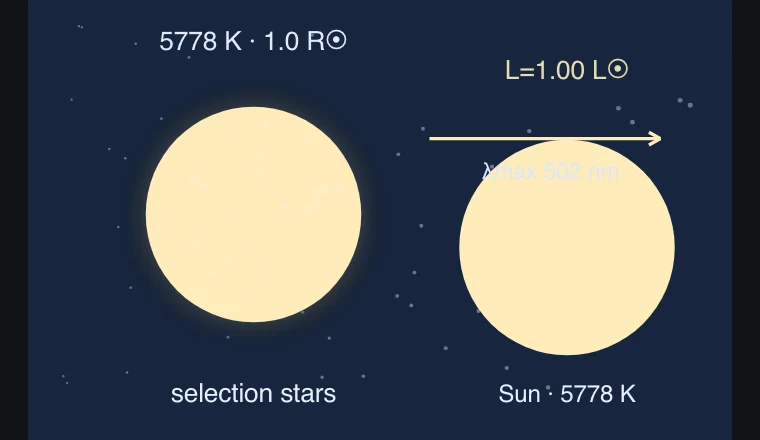
Doubling the temperature is 16 times the luminosity, and doubling the radius is 4 times the luminosity. Distance does not change luminosity.
Assume the star is a black body of uniform temperature. T☉=5778 K, use the Wien’s displacement constant 2.898×10⁻³ m·K. Apparent brightness is a relative value of L/d², omitting the common 1/(4π). The colors are approximations for the screen based on temperature, and the radius plot is logarithmic scale. Interstellar extinction, absorption lines, and stellar evolution paths are not calculated.
Key relationships and symbols
L/L☉=(R/R☉)²(T/5778)⁴ · λmax=2.898×10⁶/T nm
| Symbol | Meaning | Unit |
|---|---|---|
| L | Luminosity | W |
| F | Observed power per unit area | W/m² |
| T | Effective temperature of the stellar surface | K |
Worked example
What changes if the same star moves twice as far away?
The luminosity L is the amount of emission of the star itself. The apparent brightness is proportional to L/d², so when the distance is doubled, it becomes 1/4.
Common misconceptions
- The fact that an observer moves away does not mean that the luminosity of the star itself decreases.