
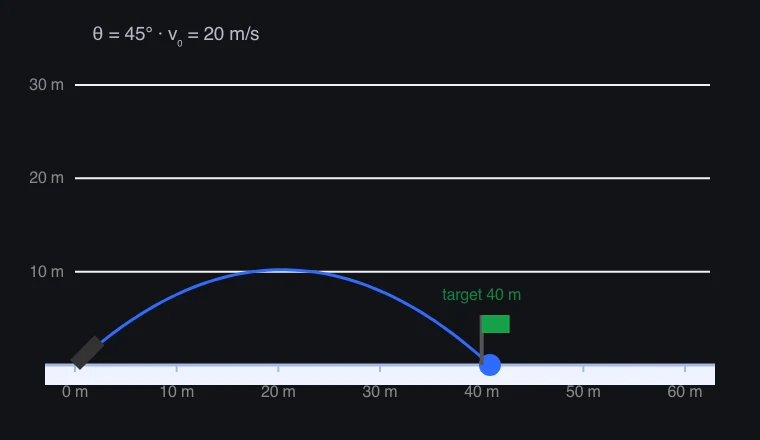
The reason for dividing one movement into two directions.
When launched at an angle θ towards the horizontal with an initial velocity v₀, the horizontal velocity is v₀cosθ, and the initial upward velocity is v₀sinθ. Since there is no force in the horizontal direction, the horizontal velocity remains constant. In the vertical direction, which is defined as positive upwards, an acceleration of −g is applied.
Both directions share the same time t. After calculating how far they move horizontally and how high they go, and then pairing the coordinates at the same time, this creates a curved trajectory. At the peak, only the vertical velocity is 0, and the horizontal velocity does not disappear; it is simply zero.
Why does a 45° launch angle give the greatest range when launch and landing heights are equal?
With equal launch and landing heights, flight time is 2v₀sinθ/g and range is R = v₀²sin(2θ)/g. At a fixed initial speed, the range is greatest at 45°, where sin(2θ) is maximal. Complementary angles such as 30° and 60°, whose sum is 90°, give the same range but different peak heights and flight times.
If the launch point is higher than the ground, the projectile can travel for a longer time, even with a lower angle. In this case, you must solve the condition y = 0 to calculate the time, and you should not assume that the optimal angle is always 45°. This deviates from the ideal range formula when considering air resistance or the projectile’s rotation.
What should you read from the graph?
In a graph of position over time, the horizontal position increases linearly, while the vertical position appears as a parabola opening downwards. In a graph of velocity, the horizontal component is constant, and the vertical component is a straight line with a slope of −g.
Comparing only the trajectory, it’s easy to miss the difference in motion. Even if the projectiles reach the same target, those with a higher angle will go higher and stay in the air for a longer time. When changing the angle, maintaining a constant initial velocity and launch height allows us to differentiate the causes.
Key relationships and symbols
x = v₀cosθ · t · y = h + v₀sinθ · t − ½gt² · R = v₀²sin(2θ)/g (equal launch and landing heights)
| Symbol | Meaning | Unit |
|---|---|---|
| v₀ | initial speed | m/s |
| θ | Launch angle relative to the horizontal | ° or rad |
| h | Launch height relative to the landing surface | m |
| R | Horizontal range | m |
Worked example
If launched at the same height to 14 m/s with an angle of 45°, what would be the range?
The result of g = 9.8 m/s² is R = 14² × sin90° / 9.8 = 20 m. If the initial velocity is doubled, the range at the same angle becomes four times greater.
Common misconceptions
- Even at the highest point, gravity and gravitational acceleration continue to act.
- The maximum range at 45° applies when launch and landing heights are equal and air resistance is neglected.