
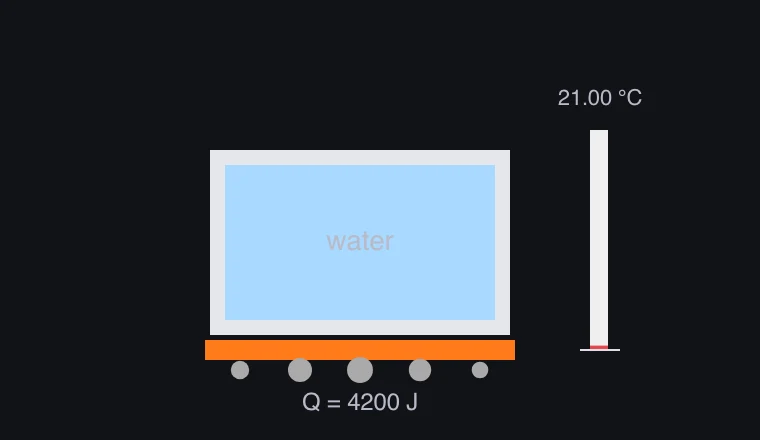
If the specific heat capacity is large, then the same substance will become less hot.
If no phase change occurs and specific heat c can be treated as constant, the supplied heat is Q = mcΔT. At the same Q and m, ΔT = Q/(mc), so higher specific heat gives a smaller temperature change. Water has a higher specific heat than many metals, requiring more energy to warm the same mass by the same amount.
Heat capacity C = mc is the energy required to raise the temperature of an entire object by 1 K. The unit for specific heat is J/(kg·K), and the unit for heat capacity is J/K. Even with the same material, heat capacity increases as the quantity increases, while the specific heat remains constant under the same conditions.
When do the same heating time and the same amount of heat result in the same outcome?
When a specific effective heating power, P, is delivered to all of the samples, Q = Pt is achieved. If the power differs, even when heated for the same duration, the amount of heat received will be different. In comparative experiments, it is verified what among mass, heating power, and time was kept constant.
If heat escapes to the surroundings or also warms the container, not all the heater’s electrical energy raises the sample’s temperature. Measuring specific heat requires accounting for the container’s heat capacity, heat loss, and the thermometer’s response.
Distinguish temperature change from phase change
The temperature difference 1 °C has the same magnitude as 1 K, so the same numerical value can be used for ΔT. However, absolute temperature 20 °C and 20 K are not the same. When heat received is represented as a positive value and heat released is represented as a negative value, the cooling process can also be expressed in the same manner.
During the periods when ice is melting or water is boiling, the temperature can remain constant even if energy is added. This occurs within a range that requires latent heat, and cannot be explained solely with Q = mcΔT. The experiment covers a range where the specific heat is constant and there is no heat loss due to phase changes.
Key relationships and symbols
Q = mcΔT · C = mc · Q = Pt (constant power, no losses)
| Symbol | Meaning | Unit |
|---|---|---|
| Q | Heat received by the object | J |
| m | mass | kg |
| c | specific heat | J/(kg·K) |
| ΔT | final temperature − initial temperature | K or °C |
Worked example
How much does the temperature of 0.5 kg of water rise when it receives 4200 J of heat?
Using the simulation’s water specific heat of 4200 J/(kg·K) gives ΔT = 4200/(0.5 × 4200) = 2 K. With no heat loss, this equals the energy supplied by heating at 100 W for 42 seconds. Doubling the water mass halves the temperature rise.
Common misconceptions
- A substance with a high specific heat does not undergo a larger temperature rise for the same heat input.
- Providing heat does not always result in an increase in temperature. When in the phase transition region, we consider latent heat.
Explore this concept through experiments
Comparing temperature increases when only the material is changed, while maintaining the same mass, power, and time; or when only the mass is changed while maintaining the same power and time.
Heat conduction in a rodPlease compare the concept of a property of storing heat and the speed at which heat is transferred – these are distinct concepts.