
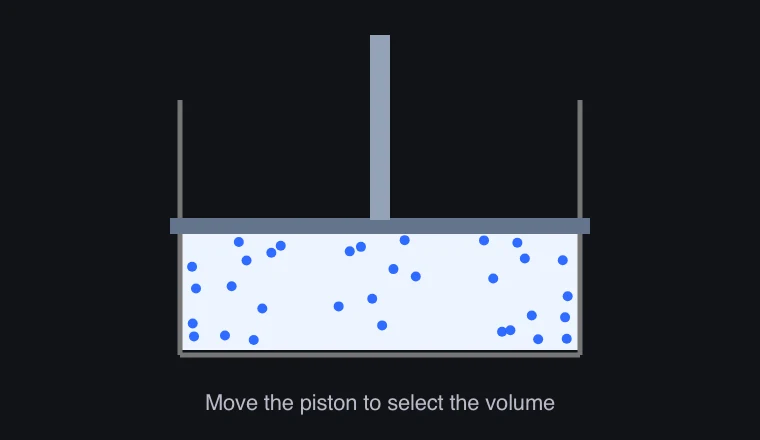
Proportional reasoning involves conditions that must be fixed.
The equation for an ideal gas is PV = nRT. If the number of moles, n, and the absolute temperature T are equal, then the right-hand side is constant, meaning P₁V₁ = P₂V₂. If the volume is halved, the pressure doubles; if the volume is doubled, the pressure is halved.
If the vessel is contaminated or the temperature changes, the comparison conditions differ. Rapidly compressing a syringe can cause the temperature of the gas to increase, which differs from an isothermal process. When conducting experiments based on the ideal gas law, it’s important to remember that we are comparing equilibrium states with a fixed temperature.
Check the temperature and pressure references
The equation of state uses kelvin, not Celsius: T(K) = t(°C) + 273.15. At 0 °C, gas particles do not stop moving. Use absolute pressure measured from vacuum; do not substitute gauge pressure, which excludes atmospheric pressure.
Units must be consistent. With P in Pa and V in m³, R ≈ 8.314 J/(mol·K). With P in kPa and V in L, the same numerical value of R works because 1 kPa·L = 1 J. Mixing liters and cubic meters can cause a factor-of-1000 error.
How should we read graphs and particle diagrams?
On graphs of P-V for the same n and T, the curve is an inverse relationship. If the horizontal axis is changed to 1/V, then P = nRT(1/V), and this results in a straight line with a slope of nRT. This is a method to verify the inverse relationship by changing the curve into a straight line.
The pressure of the object is linked to the effect where molecules transfer their motion by colliding with a wall. However, the moving element in the experiment is for illustrative purposes, and the pressure is calculated using the ideal gas law. It is not a model where one actually counts the number of molecules or measures pressure by counting the number of collisions of the points. When the pressure is high or near the liquefaction point, the actual gas deviates from the ideal gas approximation.
Key relationships and symbols
PV = nRT · P₁V₁ = P₂V₂ (constant n and T) · T(K) = t(°C) + 273.15
| Symbol | Meaning | Unit |
|---|---|---|
| P | Absolute pressure | Pa or kPa |
| V | Volume | m³ or L |
| n | Amount of gas | mol |
| T | Absolute temperature | K |
Worked example
At constant temperature, what happens when a gas initially at 100 kPa and 2 L is compressed to 0.5 L?
This is P₂ = P₁V₁/V₂ = 100 × 2/0.5 = 400 kPa. This is absolute pressure. If the temperature changes while compressing, we cannot apply the same calculation directly.
Common misconceptions
- The Boyles’ Law is a law that compares the relationship between temperature and the amount of gas, when comparing only constant amounts of gas.
- The statement that pressure is inversely proportional to volume means that the P-V graph is a downward-facing straight line.