
Thermal conductivity and thermal diffusivity differ
Heat-transfer rate along a uniform rod follows Fourier’s law. A larger temperature gradient, cross-sectional area, or thermal conductivity k gives a greater heat-transfer rate. Heat flows toward lower temperature.
Thermal diffusivity α = k/(ρc) describes how quickly a temperature distribution changes; ρ is density and c is specific heat. Higher thermal conductivity alone does not ensure a proportional increase in the rate of temperature change. Energy storage per unit volume also matters.
Even in a normal state, heat can flow.
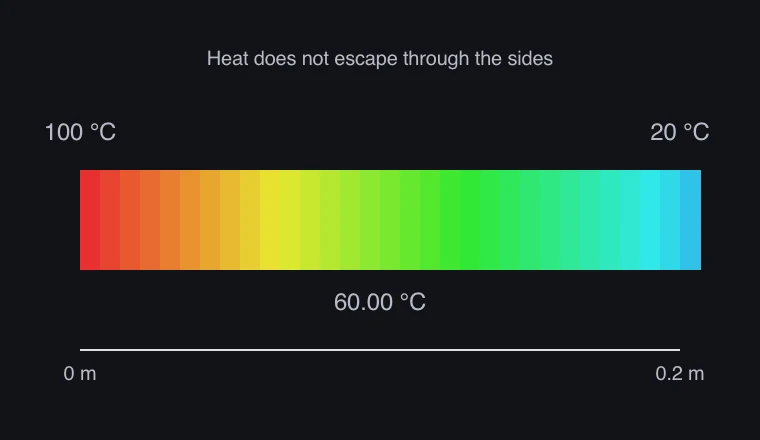
If the temperatures at both ends of the uniform rods are maintained at a constant level and there is no lateral heat loss, the temperature distribution will approach a straight line after a sufficient period of time. The temperature at each point will not change further, but heat will continue to flow from the hot storage to the cold storage.
This is a steady state, distinct from thermal equilibrium, where the temperature is uniform and there is no heat flow. With fixed endpoint temperatures, the final linear temperature profile can be independent of thermal conductivity, while the heat-transfer rate still depends on it.
How does a longer rod affect the time required?
The characteristic timescale at which temperature distributions stabilize is proportional to L²/α. If the length is doubled, while using the same material, the characteristic time is approximately four times longer. However, the precise time at which specific temperatures or a given error range are reached depends on the boundary conditions and the initial distribution.
The experiment involves a 1-dimensional rod, with its ends maintained at a constant temperature. It excludes lateral convection and radiation, contact resistance, and temperature dependence of the material, and rapidly advances physical time. Instead of just observing the same display time, it compares the displayed physical time and temperature distribution.
Key relationships and symbols
Q̇ = −kA dT/dx · α = k/(ρc) · ∂T/∂t = α∂²T/∂x² · timescale ∝ L²/α
| Symbol | Meaning | Unit |
|---|---|---|
| k | Thermal conductivity | W/(m·K) |
| α | Thermal diffusivity | m²/s |
| ρ | Density | kg/m³ |
| Q̇ | Heat transferred per unit time | W |
Worked example
What is the steady-state midpoint temperature of a uniform rod whose ends are held at 80 °C and 20 °C?
With no lateral heat loss and constant thermal conductivity, the steady profile is linear, so its midpoint is 50 °C. Rods with different thermal diffusivities can reach the same final midpoint temperature under the same boundary conditions, while their approach rates and heat-transfer rates may differ.
Common misconceptions
- Heat transfer can continue in a steady state even when temperature at every point is constant over time.
- High specific heat and rapid heat conduction are different properties.
Explore this concept through experiments
Maintain the extreme temperatures, while changing the material and length, and then compare the distribution and final distribution.
Specific heat and temperaturePlease differentiate between temperature increases due to the same energy and heat transfer that varies with space.