
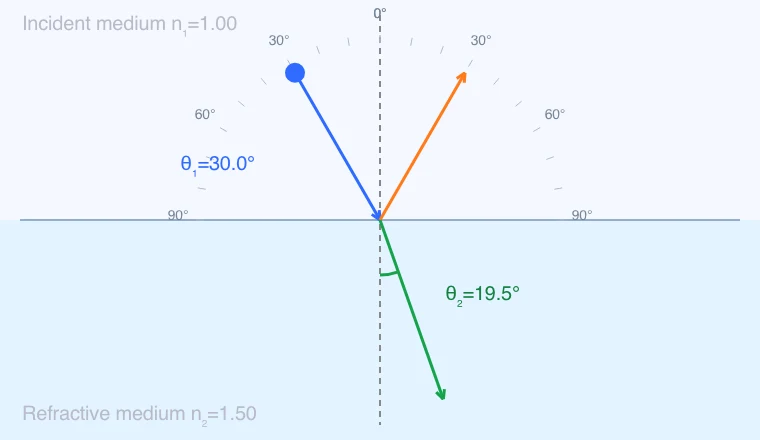
Check the two conditions in order
The first condition is n₁ > n₂. Total internal reflection can occur from glass to air, but not from air to glass. The second condition is an incidence angle, measured from the normal, greater than the critical angle.
The critical angle is the incidence angle for which Snell’s law gives a refraction angle of 90°, so sinθc = n₂/n₁. A smaller refractive-index ratio n₂/n₁ gives a smaller critical angle. A large incidence angle alone does not establish total internal reflection.
Just below, at, and above the critical angle are different
Below the critical angle, refracted light can propagate in the lower-index medium. At the critical angle, the ideal refracted ray travels along the boundary. Above it, Snell’s law has no real-valued angle for a propagating refracted ray.
In the wave description, total internal reflection can still produce an evanescent field that decays exponentially near the boundary in the lower-index medium. It is therefore inaccurate to say that no electromagnetic field exists on the other side. This page and its ray model address whether a refracted ray propagates away from the boundary.
How is this used in optical fibers?
Optical fibers are manufactured with a refractive index higher than the cladding surrounding the central core, enabling them to scatter light. When light enters in a suitable direction, it satisfies the conditions for total internal reflection at the core boundary and proceeds. This can be described as a path where light is repeatedly reflected in a simple light ray diagram.
It is not the case that all light entering in any direction is automatically trapped. The angle of the entrance, the refractive indices of the core and cladding, and the degree of bending all influence transmission. For extremely thin fibers, the actual modes and losses require a more detailed wave analysis than a single boundary ray model.
Key relationships and symbols
sinθc = n₂/n₁ (n₁ > n₂) · total internal reflection when θ_incident > θc
| Symbol | Meaning | Unit |
|---|---|---|
| n₁ | Refractive index of the incident medium | Dimensionless |
| n₂ | Refractive index of the other medium | Dimensionless |
| θc | Critical angle measured from the normal | ° or rad |
Worked example
What is the critical angle when a sphere exits a glass with a refractive index 1.5 and moves into air?
The angle is θc = arcsin(1/1.5) ≈ 41.8°. At 30°, there is refraction, and at 50°, there is total internal reflection. If the incident medium is reversed, i.e., the medium in which light is incident is flipped, then this total internal reflection condition does not apply even at 50°.
Common misconceptions
- Increasing the incidence angle when light travels from air into glass does not produce total internal reflection in this direction.
- The critical angle is an incidence angle that gives a refraction angle of 90°; it is not the angle of reflection.