
Meaning and mechanism
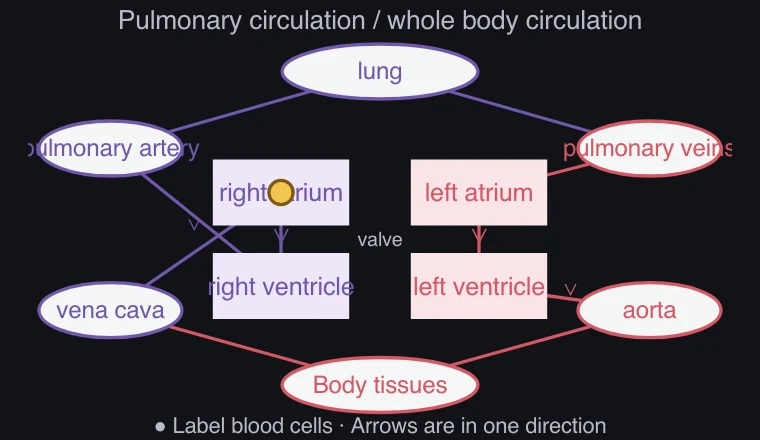
From the right ventricle, blood traveling to the lungs obtains oxygen, and then returns to the left ventricle. The left ventricle pumps blood throughout the entire body, and the blood from the entire body returns to the right ventricle.
Heart valves reduce backward blood flow. The two circulations are connected in series, linking gas exchange in the lungs with the exchange of substances in the tissues.
Relationships and conditions
The primary circulation route is: heart → lungs → left heart → throughout the body → right heart. The average flow rate of the two normal circulatory systems must be in balance.
The pulmonary artery carries deoxygenated blood, while the pulmonary veins carry oxygenated blood. The color of the model indicates the level of oxygenation, and does not represent the actual blue color of the blood.
What to observe in the simulation
Right atrium → right ventricle → pulmonary artery → lungs → pulmonary veins → left atrium → left ventricle → aorta → whole body → vena cava → right atrium. Valves prevent reflux.
It is a virtual path state model that follows one blood cell. The oxygen relative amount 0.25·0.95 and travel time are for explanatory purposes only. The color changes after passing through the lungs and the entire body, and the actual oxygen exchange is a continuous process. The actual size, location, and simultaneous beating of the heart and blood vessels have been simplified. It does not cover quantitative prediction of blood pressure, flow rate, coronary circulation, fetal circulation, or diseases.
Key relationships and symbols
Right heart → pulmonary circulation → left heart → whole body circulation → right heart
| Symbol | Meaning | Unit |
|---|---|---|
| Pulmonary circulation | Path from the right heart through the lungs to the left heart | channel |
| Systemic circulation | Path from the left heart through the tissues to the right heart | channel |
Worked example
What is the role of heart valves?
Valves open and close due to pressure differences, helping with one-way flow. It receives oxygen from the lungs and delivers oxygen throughout the body. The pulmonary artery has less oxygen and the pulmonary veins have more oxygen.
Common misconceptions
- Not all arteries transport oxygen-rich blood.