
Meaning and mechanism
Ventilation is a mechanical process involving the movement of air into and out of the body. It is not simply the exchange of gases, such as the movement of oxygen and carbon dioxide across a barrier.
When the diaphragm contracts and descends, and the chest expands, the lungs expand along with it. A pressure difference arises, causing air to flow from the airways into the lungs.
Relationships and conditions
In a simple model of an isothermal gas, when PV is constant, as the volume increases, the pressure decreases. The direction of airflow is determined by the pressure difference between the inside of the lung and the surrounding atmosphere.
The actual lung is influenced by open breathing, elastic tissue, and the effects of the pleural membrane and surfactants. The pressure in a sealed bottle and a balloon model is not equated with the actual lung pressure.
What to observe in the simulation
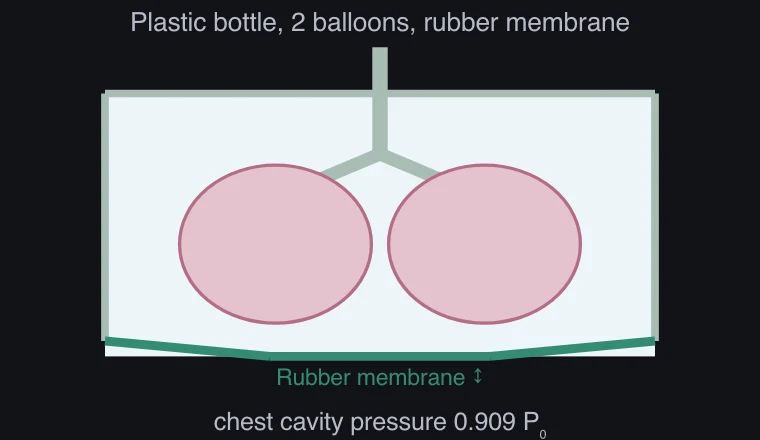
When the rubber membrane is pulled, the volume of the chest cavity increases and the pressure decreases, allowing air to enter the balloon. When the curtain rises, the air comes out. When the airway is closed, there is no air movement.
It is a virtual relative value obtained by applying Boyle's law by considering the thoracic space as a sealed gas at a certain temperature. The balloon approaches the target volume 1+0.8×(V/V₀−1) exponentially. Actual pleural pressure, lung elasticity, thoracic movement, and gas exchange are omitted. A closed balloon is an approximation that also fixes the volume. It does not predict the actual pressure or breathing volume of the human body.
Key relationships and symbols
P/P₀ = V₀/V · Chest cavity volume 1.1V₀ → Pressure P₀/1.1
| Symbol | Meaning | Unit |
|---|---|---|
| P | Gas pressure | Pa or relative pressure |
| V | Volume occupied by the gas | Volume |
Worked example
When the airway is closed and the rubber membrane is pulled, what happens to the air movement in this model?
Chest cavity pressure decreases to PV = constant. When the airway is open, the balloon grows larger and allows air to flow in, but when it closes, the air movement is zero. In this simple model, the closed balloon volume is also fixed.
Common misconceptions
- During inhalation, air entering does not first enlarge the chest cavity. Muscle movement creates the pressure difference that drives airflow.