
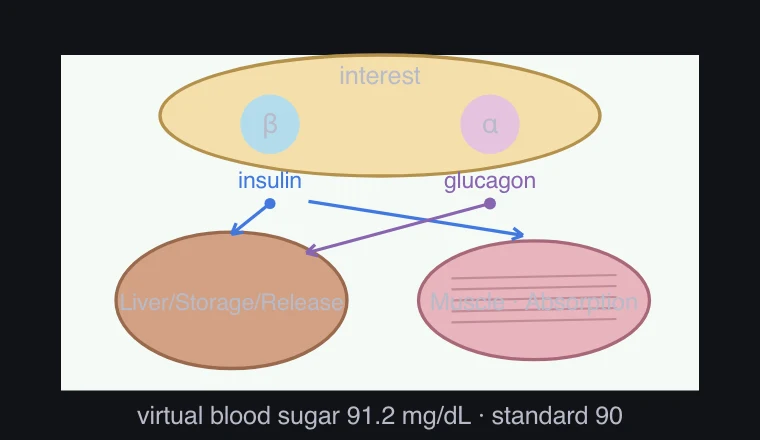
Meaning and mechanism
When blood glucose rises after a meal, insulin helps cells use and store glucose. When blood glucose falls, hormones such as glucagon help supply glucose to the blood.
A regulatory response is negative feedback if it reduces the initial change. Even with stronger regulation, the shape of the return can vary with response time and delay.
Relationships and conditions
The experiment connects the difference from the baseline blood sugar with hormone responses using a simple differential equation. After controlling for meal size and exercise conditions, it compares the presence or absence of feedback.
The presented figures and reactions are a model for conceptual learning. They are not a clinical model for predicting an individual’s hormone response or disease status.
What to observe in the simulation
Meal input is reduced, but if feedback is turned off, high variation remains. When turned on, the deviation is reduced due to the action of insulin.
This is a virtual model for educational purposes, not for judging personal health. 90 mg/dL is for illustration purposes only. x only represents deviations above the standard and does not reproduce hypoglycemia below the standard. α cells are a proxy function that responds to small deviations and exercise demands. Meal input 0.16·meal amount·exp(−0.16t), insulin removal 0.018Ix, hormone disappearance 0.16I·0.15Gl, etc. are integrated by RK4 (1/60 min). It does not predict actual hormone concentrations, diseases, drugs, or individual differences.
Key relationships and symbols
Blood sugar = 90 + x · x, I, Gl ≥ 0
| Symbol | Meaning | Unit |
|---|---|---|
| x | Deviation from the reference blood glucose level | Relative simulation units |
| Counting feedback | Magnitude of the response that reduces the deviation | Model coefficient |
Worked example
Why does insulin action increase after blood sugar levels rise?
Insulin action refers to storage and absorption in the liver and muscles, and glucagon action refers to liver release. The adjustment in the direction of reducing the deviation is called negative feedback.
Common misconceptions
- In negative feedback, “negative” means that the response opposes the initial change; it does not mean that the response is bad.