
Meaning and mechanism
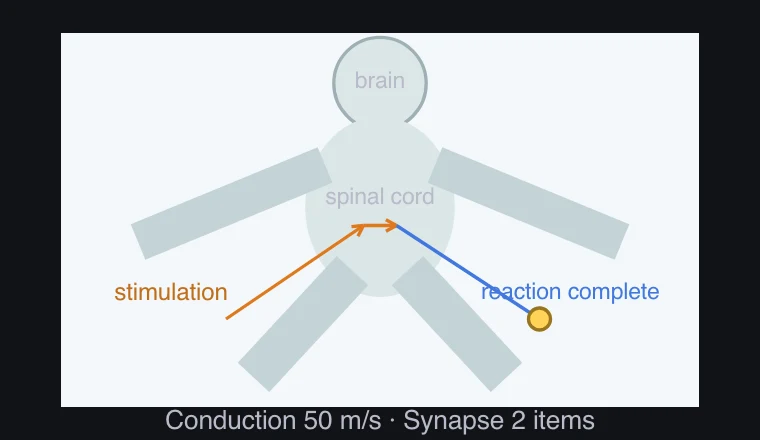
Sensory receptors receive stimuli, which are processed within the nervous system, and motor signals are transmitted to effector organs. Reflex circuits can generate responses prior to conscious judgment.
At the axon, electrical signals are transmitted, while in chemical synapses, transmission occurs through neurotransmitters. Each transmission process requires a specific amount of time.
Relationships and conditions
The total time for a simple model is calculated by adding the length/speed of each segment and the synaptic delay. Even if the speed is the same, if the path is long or the number of synapses is large, the delay will increase.
The conduction velocity depends on the diameter of the axon, as well as the number of synapses and other factors. The observed synaptic delay in the experiment represents an average, and not all neural circuits operate identically.
What to observe in the simulation
Fast conduction reduces movement delay, and long paths and many synapses increase delay.
Use a virtual length, constant conduction velocity, and 0.5 ms per synapse. The circuit and number of synapses of the actual knee reflex have been simplified. Ankle pick is a comparative model of spinal reflexes. Sensory reception, muscle contraction time, and brain judgment time are omitted. Silhouettes are not to anatomical scale and do not predict individual reaction speed.
Key relationships and symbols
Total delay = Σ(length / speed) + number of synapses × 0.5 ms
| Symbol | Meaning | Unit |
|---|---|---|
| L/v | Conduction time along a nerve segment | s |
| Synaptic delay | Transmission time at the junction | ms |
Worked example
What is the total delay of 1.6 m·50 m/s·2 synapses×0.5 ms?
1.6/50=0.032 s=32 ms. Add 2×0.5=1 ms to get 33 ms.
Common misconceptions
- Although conscious judgment by the brain is not necessary for reflection, the nervous system is not uninvolved.