
Meaning and mechanism
Diffusion is the phenomenon of a distribution spreading out due to the random motion of particles. The process of a specific particle determining which direction to move towards, based on concentration, is not part of diffusion.
When the concentration is high, there are more particles that cross the boundary. Even if bidirectional movement is present, a difference in the amount of movement observed is seen moving from the higher concentration area to the lower concentration area.
Relationships and conditions
In closed spaces, the total number of particles is conserved. If the volumes are equal, the average number of particles will be the same in equilibrium, but there will be variation in the instantaneous values of individual trials.
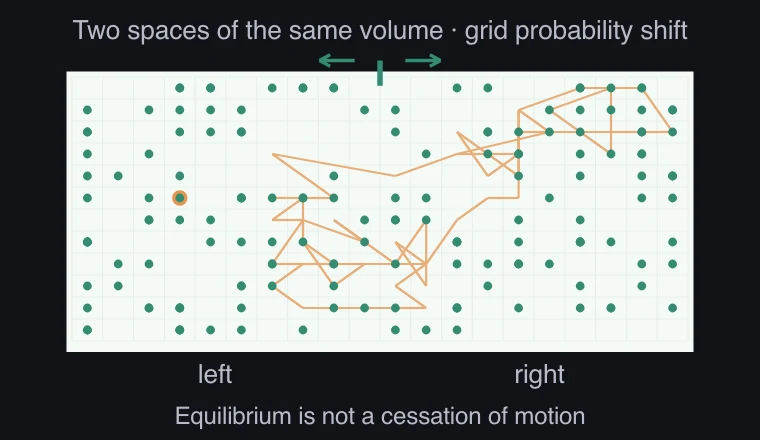
Equilibrium is not the stopping of particles, but rather a state where bidirectional movement achieves balance. The actual diffusion rate is influenced by factors such as temperature, medium, particle size, and boundary conditions.
What to observe in the simulation
The concentration difference decreases, but random movement in both directions continues even at equilibrium. The total number of particles is preserved.
It is a 20×12 grid probability movement model of two spaces of the same size and a single particle species. Particle collision, volume, and electric force are omitted and a maximum of 400 are used. Concentration is compared by the number of particles in the same space. The stop at the end of the observation section means that time has stopped playing. It's not actual molecular suspension.
Key relationships and symbols
Total number of particles N = N left + N right
| Symbol | Meaning | Unit |
|---|---|---|
| N | Total number of particles | items |
| C | Number of particles per unit volume | particles/volume |
Worked example
Why do left-to-right and right-to-left crossings continue to accumulate at equilibrium?
Even in equilibrium, movement in both directions continues. In small samples, the number of left and right particles is not exactly the same and constantly fluctuates.
Common misconceptions
- Even if the concentrations become equal, the random movement of particles continues.