
Meaning and mechanism
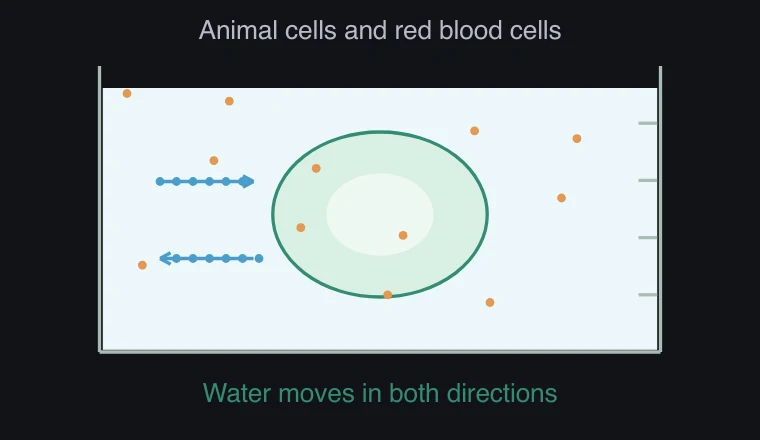
Across a membrane permeable to water but not to certain solutes, a difference in water’s chemical potential drives net water movement. Water tends to move from the more dilute side to the more concentrated side.
If the concentration of impermeable solutes outside is low, water can enter the cells, leading to an increase in volume. Conversely, if the outside is highly concentrated, water can be expelled, resulting in a decrease in volume.
Relationships and conditions
With a fixed internal amount of solute, the simulation’s ideal equilibrium relation is V/V₀=C_initial_inside/C_outside. Internal concentration changes as water moves, so it is not held at its initial value throughout.
The equation neglects pressure differences across the membrane and cell-wall elasticity. Actual isotonicity depends on membrane permeability, not just the total concentration of all solutes.
What to observe in the simulation
In a hypertonic solution, net water loss shrinks the cell. In a hypotonic solution, net water uptake enlarges it. Animal cells can undergo hemolysis; plant cells develop turgor pressure.
This dilute-solution model allows only water to cross and keeps solute moles fixed. Net movement approaches equilibrium exponentially. A red-cell ratio V/V₀>1.6 is an artificial hemolysis threshold, after which volume calculation and water movement stop. Plant cells use an artificial upper bound of 1.15. Turgor pressure is a relative value proportional to concentration difference, not an actual pressure. Do not use the model to predict real cells quantitatively.
Key relationships and symbols
Ideal equilibrium V/V₀ = Cᵢₙ,₀/Cₒᵤₜ
| Symbol | Meaning | Unit |
|---|---|---|
| V, V₀ | Final and initial volumes | Relative volume |
| C | Concentration of impermeant solutes | mol/volume |
Worked example
Why do plant cells not grow infinitely in hypotonic solution?
Assume a membrane that only allows water to pass through. In plants, the cell wall and turgor pressure oppose the net influx of water, and this model limits V/V₀ to 1.15.
Common misconceptions
- It is not necessarily the case that the solute itself must cross the membrane in osmosis.