
Meaning and mechanism
Mitosis distributes replicated genetic information to two daughter cells. A typical diploid cell replicates its DNA before undergoing one division.
Duplicated chromosomes contain two sister chromatids. Prior to their separation, they are counted as a single chromosome based on the linked centromere units.
Relationships and conditions
After S phase, DNA content doubles, but chromosome number remains unchanged until separation. Once sister chromatids separate, each counts as a chromosome; the cell boundaries must also be checked.
It clearly specifies whether the discussion is based on one cell or one nucleus. This model focuses on representative division sequences, omitting division errors and exceptions.
What to observe in the simulation
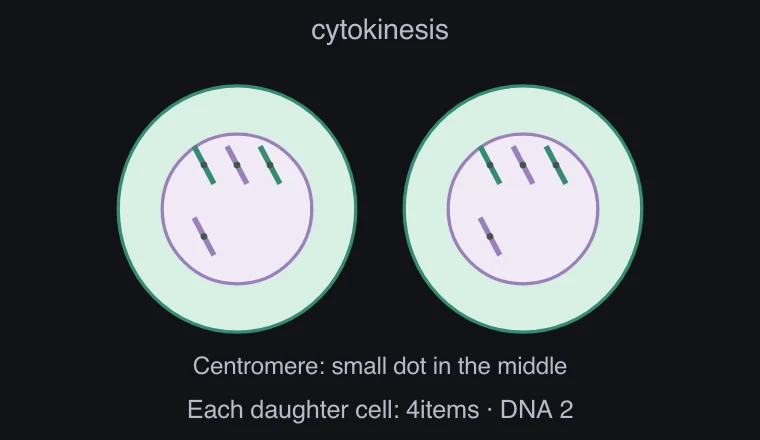
In S phase, DNA is copied from 2 to 4, but the number of chromosomes is the same. The total number of chromosomes in the anaphase cell doubles, and each daughter cell returns to its original number and DNA relative amount of 2.
This simplified stage model represents one normal somatic cell with 2n=4 or 6. Chromosomes are counted by centromeres, and relative DNA content is normalized to G1 DNA=2 for each selection. From prophase through anaphase, the nuclear envelope is absent, so a per-nucleus value is undefined. Telophase distinguishes the whole undivided cell from its two new nuclei; cytokinesis reports one daughter cell. Stage timing and chromosome shapes are illustrative, not actual cell-cycle durations; division errors and meiosis are omitted.
Key relationships and symbols
The number of chromosomes is based on the centromere. The amount of DNA is relative.
| Symbol | Meaning | Unit |
|---|---|---|
| n | Number of chromosomes in one set | items |
| C | Reference haploid DNA content before replication | relative amount |
Worked example
At 2n=4, what are the total number of chromosomes and relative amounts of DNA in the anaphase cell?
In anaphase, the centromeres of sister chromatids are separated and each is counted as a chromosome. Since no new DNA is synthesized, the total DNA of the cell is 4, the same as G2. There are 4 DNA 2 at one pole.
Common misconceptions
- It’s not possible to say that the moment when the amount of DNA doubles is immediately the moment when the number of chromosomes doubles.